Since 2000, Dēmos has worked at the intersection of economic justice and democracy reform, offering people-centered solutions that tackle economic inequality and advance racial equity. We do this work to realize our vision of a just, inclusive multiracial democracy and economy. Central to our work has been exposing how the legacy of racism and the ills of anti-Blackness animate the struggle for economic and political power—especially for Black and brown people, the nation's rising majority. Building economic and political power for them is the mission of our time.
Today, the stakes are higher as more threats loom that undermine economic and political power for the multiracial working class. As authoritarianism rises, coupled with the outsized influence of the ultra-wealthy in our politics and economy, we must act with urgency to redistribute wealth, rebuild our democratic systems, and ultimately rebalance power so that people power endures. By pairing populist policies with structural solutions, we can build lasting people power.
NINE POLICIES FOR LASTING PEOPLE POWER
Three Populist Policies
- Affordable Housing
- Universal Child Care
- Wealth Tax
Six Structural Solutions
- Redistricting Reform
- Automatic Voter Registration
- Universal Vote by Mail
- Public Banks
- Public Dollars for Worker Power
- Democracy Vouchers
This is not a comprehensive list. It is our hope that Dēmos’ Policy Agenda will inspire others to identify and craft their own power policies.
Context: This Chapter Is a Continuation of the American Story
Since January 2025, we have watched our young, multiracial democracy backslide into authoritarianism at an alarming speed. Under a government animated by unapologetic white supremacy, our institutions have buckled, and our media have been muzzled. We’ve seen the dollars that once paid for health care for millions redirected to the pockets of the already wealthy. We’ve seen the erasure of protections that ensure Black and brown Americans can cast a ballot and have it count. And we’ve seen members of our communities—neighbors and friends—snatched off the street and deported without due process, and the people who tried to protect them summarily killed by officers of the state.
It is devastating to witness such a regression. And it may feel unprecedented. But as a nation, we’ve been here before. Most notably, since the close of the Civil War, white supremacists and proponents of a multiracial democracy have battled for power over this nation. We are in a new chapter of this struggle, and the white supremacists working to ensure white minority rule are winning—for now.
We can take inspiration from those who came before us, those who organized and won. Their histories remind us that, in times of profound upheaval, there is also profound opportunity.
But we can take inspiration from those who came before us, those who organized and won. Their histories remind us that, in times of profound upheaval, there is also profound opportunity. We think of the emergence of Black businesses, Black political representation, and Black power during the First Reconstruction. We think of how the victories of the Civil Rights Movement and the Second Reconstruction grew out of the authoritarian rule that was Jim Crow. We look to the organizers in the streets today—with their whistles, with their signs, with their phones and their clipboards—and we know that they are working to pry open another policy window. If we play our cards right, a Third Reconstruction will emerge.
An Imperative: The Time to Act Is Now
Now is the time to prepare for its arrival and to think big. Not just to regain governing power but to build new forms of power for proponents of a multiracial democracy that will endure.
This push and pull between white supremacy and multiracial democracy is not an abstract struggle found in history books. It’s a defining struggle of our time. We must plan for a power that lasts to finally stop the pendulum’s swing. Policy will play a key role in this project.
We believe that listening to people’s needs and then offering and delivering solutions is the key to restoring governing power for anti-authoritarians.
In the fight against authoritarianism, two camps have emerged. One camp is focused on recapturing the middle with moderate policy proposals. Another camp argues that now is the time for bold solutions. We at Dēmos are betting on bold solutions that make life better for everyday people. We believe that listening to people’s needs and then offering and delivering solutions is the key to restoring governing power for anti-authoritarians. In these pages, we share Populist Policies in this vein.
But using these bold solutions to get power is fleeting if we don’t make the structural changes needed to fundamentally shift power. So, in this vein, we then share Structural Solutions. When our economic and political structures reflect the will of the people, people power will endure.
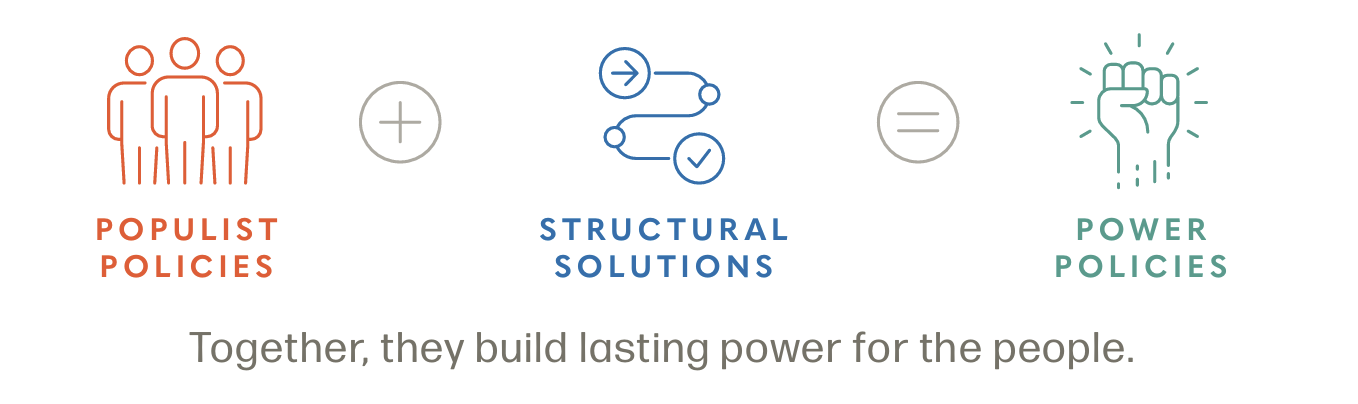
When they are coupled, Populist Policies and Structural Solutions are Power Policies. Together, they build lasting power for the people.
We wrote this agenda, composed of emblematic examples of power policies, to make an intervention in the conversations that are happening today about what comes next. When proponents of a multiracial democracy govern again, we must plan for long-term, structural change, as well as immediate relief for households in the United States. Both are necessary.
Our Theory of the Case: How to Build Durable Power
What is power?
At Dēmos, we talk about power a lot. We’ve offered thoughtful, academic definitions in the past.
But in this moment, we are speaking plainly: Power is the ability to write the rules. Power Policies enable the people, especially Black and brown people, to write the rules that shape our economy and our government, creating a more just and inclusive future.
Getting Governing Power: Populist Policies
People in the United States are suffering. Their wages are low. Their bills are high. Their rent is overdue. Endless bureaucratic loops ensnare them as they fight for medical care. Their struggles are real, but nothing is changing.
When policymakers deliver populist policies, it shows they are listening. They act boldly, crafting solutions as large as the problems they aim to address.
When policymakers deliver populist policies, it shows they are listening. They act boldly, crafting solutions as large as the problems they aim to address. These solutions change the material conditions of the multiracial working class, putting money in their pockets, medical care at their fingertips, and time at their disposal. These solutions prevent the unmerited extraction of resources from Black and brown communities by corporations and other wealthy actors. When circumstances shift in this manner, when we disrupt the avenues by which corporations and the ultra-wealthy have a stranglehold on our markets, the economic power of Black and brown communities will grow.
What do we mean by “populist policies”?
Let’s start by being clear about what we mean by populism. Populism is an approach to politics that appeals to ordinary people by painting elites as the opposition. Historically and currently, however, many populists do not have the interests of ordinary people in mind: They abandon the basic rules of governance, they use violence, and, ultimately, they take power away from people. Racism and scapegoating are commonly used tools for populists.
The populist policies we describe here diverge from that history.
Like other populist policies, the ones we describe here identify the elites, who wield economic and political power to their advantage at the expense of everyday people, as the opponent. As is the case with other populisms, our populist policies aim to appeal to ordinary people who can see themselves in their messaging, who eagerly anticipate that the policies will swiftly and resolutely improve living conditions. But unlike many populist policies of the past, our populist policies have no sordid underbelly, no ulterior motive. Our populist policies don't just identify elites as the antagonist in name, they enact solutions that effectively take away elite power. The power that populism for the people consolidates belongs to the multiracial working class.
The populist policies we describe here appeal to everyday people by using policy to disrupt elite power and radically improve material conditions.
Crucially, these ideas disrupt private markets and regulate corporate actors so that elites have less economic power and the multiracial working class has more.
The populism we are trying to advance is not a thin mask held over the face of racism. It is a populism that serves the needs of all, not one that leaves Black and brown people behind. Our populist policies are easy to understand and transformational when implemented. Crucially, these ideas disrupt private markets and regulate corporate actors so that elites have less economic power and the multiracial working class has more. These ideas are all around us: Medicare for all, free buses, a living wage. In the pages that follow, we will share three examples of policy ideas that propel populism and are central to current conversations: Universal Child Care, Affordable Housing, and Wealth Taxes.
Keeping Power: Structural Solutions
How do we build power that lasts? When the proponents of a multiracial democracy return to the halls of power, they will face a stacked deck. The Supreme Court has essentially allowed corporations and the ultra-wealthy to influence our elections—and lawmakers to heavily gerrymander congressional maps, leaving people of color underrepresented. Labor law has left unions diminished and unable to advocate for workers as they once did.
For proponents of multiracial democracy, existing structures create an environment where power is likely to be fleeting. Unequal representation and barriers to voting dilute their political power. When the people manage to win power, it often can be easily reversed in the next election cycle. Then, the structures of government—from Senate rules to the outsized role of money in politics—make it hard to legislate the people’s agenda. When legislators don’t deliver, they can’t justify retaining their governing power to their electorate.
The Electoral College, the disproportionate power of the Senate, the anti-democratic actions of the Supreme Court, the outsized role of money in politics, and federal preemption of progressive state and local policies—these are just a few of the ways that the rules are rigged so that even when in power, proponents of a multiracial democracy have difficulty enacting policies that deliver for the people. These rigged structures are what hamstrung the First and Second Reconstructions, meeting their progress with retrenchment and leaving true enfranchisement out of reach.
What do we mean by “structural solutions”?
In many ways, the U.S. Constitution is a liberatory document. But it’s also where our rules were first rigged, where our systems that concentrate economic and political power with a small number of elites began.
Our country’s Constitution hands power to white, wealthy men, at the expense of women, people of color, and people with low incomes. It legitimizes the enslavement and subjugation of Black and Indigenous people for the enrichment and benefit of the wealthy and powerful. Progress in this country has been defined by compromise—as the rules have become more fair in some ways, they have entrenched inequities in others. Over the past quarter century, right-wing actors have waged a successful campaign to rig the rules for the white and wealthy through legal, technical, and social changes that might seem mundane but fundamentally shift power in the United States.
To implement structural solutions means engaging in this terrain. It means taking a close look at the ways economic and political power are structured in the United States and intervening so that the deck is no longer stacked against Black and brown people, the multiracial working class, and anyone outside of the elite.
Structural solutions change the systems that govern political and economic power so that everyday people, especially Black and brown people, have more power, and corporations and the wealthy have less.
To ensure that power and enfranchisement are real and lasting, we must implement structural solutions that fundamentally shift the balance of power.
To ensure that power and enfranchisement are real and lasting, we must implement structural solutions that fundamentally shift the balance of power so that Black and brown communities, as well as the multiracial working class, are represented and heard. These ideas are technical, and they are powerful. In the pages that follow, we will share six examples of structural solutions that would bring about meaningful change in people's lives: Redistricting Reform, Automatic Voter Registration, Universal Vote by Mail, Public Banks, Public Dollars for Worker Power, and Democracy Vouchers.
Getting Specific: What Follows in These Pages
The policies described here are not comprehensive; they are emblematic. We selected these policies in collaboration with our movement partners because they speak to the moment we are in today.
In the pages that follow, you’ll find introductions to three populist policies and six structural solutions. When these types of policies—populist policies and structural solutions—are pursued together, they become power policies that can be used to build lasting people power. The policies described here are not comprehensive; they are emblematic. We selected these policies in collaboration with our movement partners because they speak to the moment we are in today. We plan to revisit them periodically.
The policies detailed here can be implemented at local, state, or federal levels, and we are clear which policies are appropriate for which level. It is our hope that people who read this agenda will be inspired to identify and craft their own power policies. We support you in thinking about what aspects of populist policies resonate with your base or constituency and which structural solutions will grow your base’s power the most. We at Dēmos are here to partner with you to make these power policies real. At the conclusion of our presentation of each policy idea, we share contact information for our resident experts. Please be in touch.