The following is a structural solution from Dēmos' 2026 Policy Agenda, Power Policies: How to Get and Keep People Power in the United States
The Problem
Everyone, regardless of their race, income, or ZIP code, deserves to have a voice in our democracy and a say in the policies that impact their lives. However, Americans understand all too well that today we face a coordinated system that concentrates wealth and power in the hands of a small group of people and corporations.
Over the past 16 years, following changes to campaign finance law, billionaires and corporations have become more brazen in using wealth to control policy outcomes. They tilt the rules to protect their interests, weaken public institutions, and keep people feeling divided and discouraged. Politicians are complicit, as they manipulate the rules to entrench wealthy minority rule and avoid accountability.
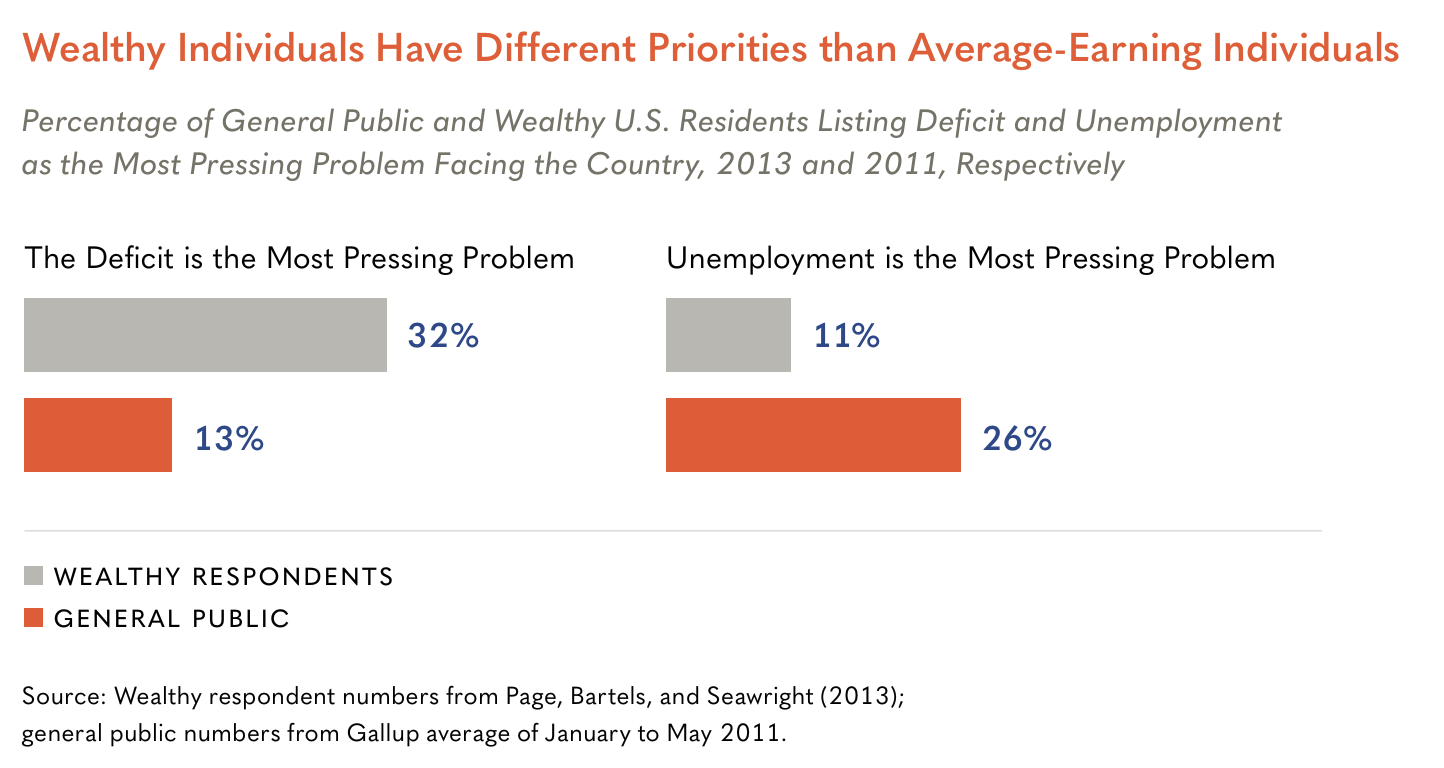
The undue influence of wealthy donors and big business runs counter to basic notions of democratic fairness and equity. But the problem is much more acute for people of color for two main reasons. First, as shown in the chart below, donor and corporate interests are different from those of everyday people. People of color are disproportionately harmed by this mismatch, because a larger percentage of people of color experience poverty or are working class due to historic, systemic exclusion from wealth-building opportunities.
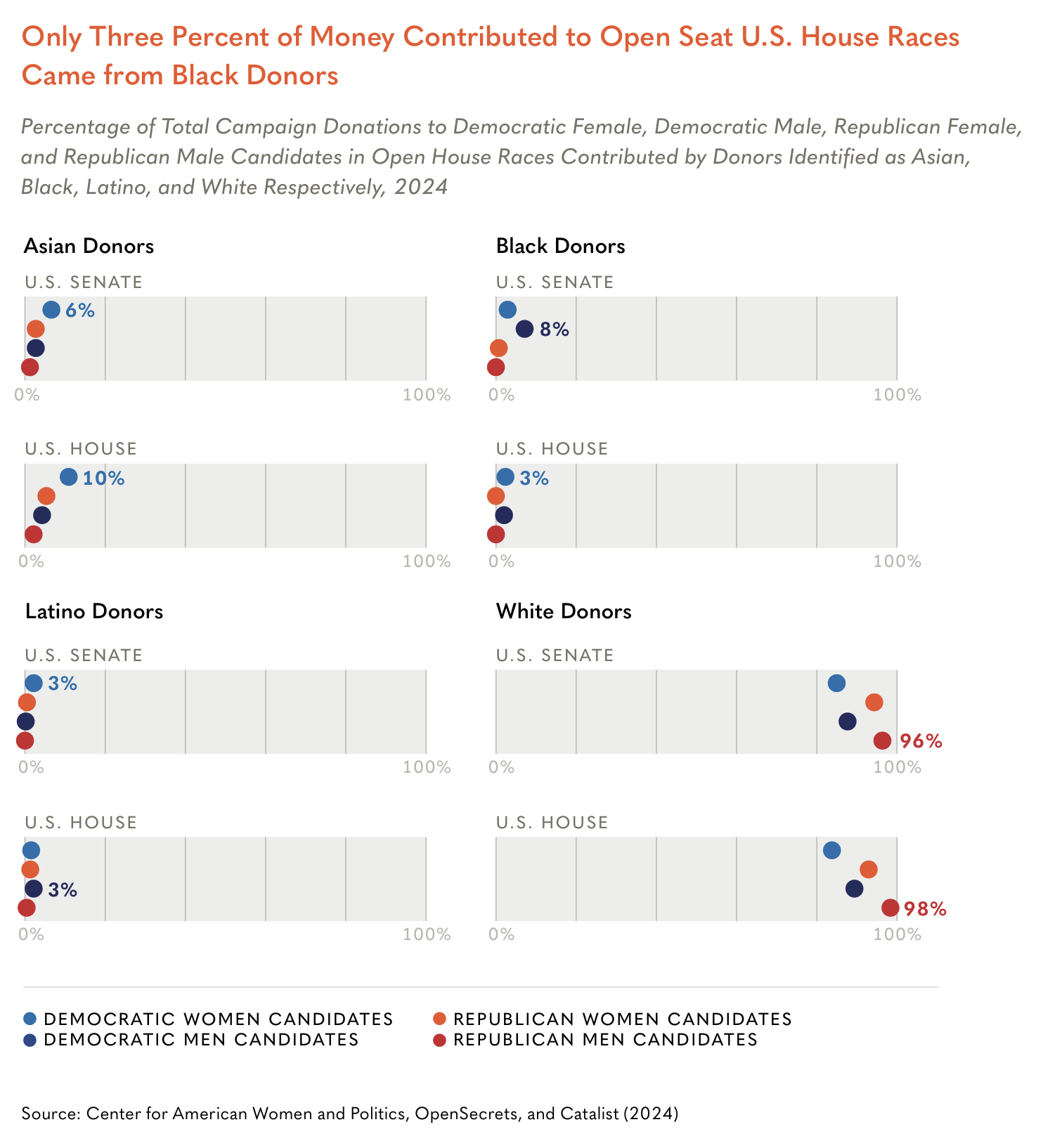
Second, the dominance of big money in our politics makes it far harder for people of color to exert political power and effectively advocate for their interests. When access and influence are tied to wealth, communities that have been systematically excluded from building wealth face additional barriers to having their voices heard by policymakers and elected officials. Both wealth and power are consolidated by a very small, very white, share of the population. This means that, as shown below, the donor class, and the influence they wield, is predominantly white.
Today, this donor class has effectively captured our democracy. Nobel-prize winning economist Paul Krugman has described the current moment as “an unprecedented power grab by America’s oligarchs.” That assessment is reflected in the surge of billionaire political spending, which has grown dramatically since court rulings in 2010 and now dramatically shapes election outcomes. In the 2024 election cycle, just 100 billionaire families contributed $2.6 billion—roughly one in every six dollars spent in federal elections. This gives wealthy donors and corporations severely disproportionate influence over who runs for office and who wins. That influence also shows up in policy. Candidates backed by wealthy donors continue to support tax packages that deliver hundreds of billions to the top one percent and have pushed to weaken regulations on industries such as tech and crypto to further their donor’s wealth.
There’s a Policy Solution for That
We can rebalance the scales. "Small donor democracy” reforms shift power to Black and brown communities through public financing programs that amplify their voices. Implementing democracy vouchers is one such strategy that both multiplies the contributions of small donors and minimizes the influence of the wealthy elite.
Democracy vouchers are small amounts of public funds that are made available to each eligible resident to donate to a participating candidate of their choice.
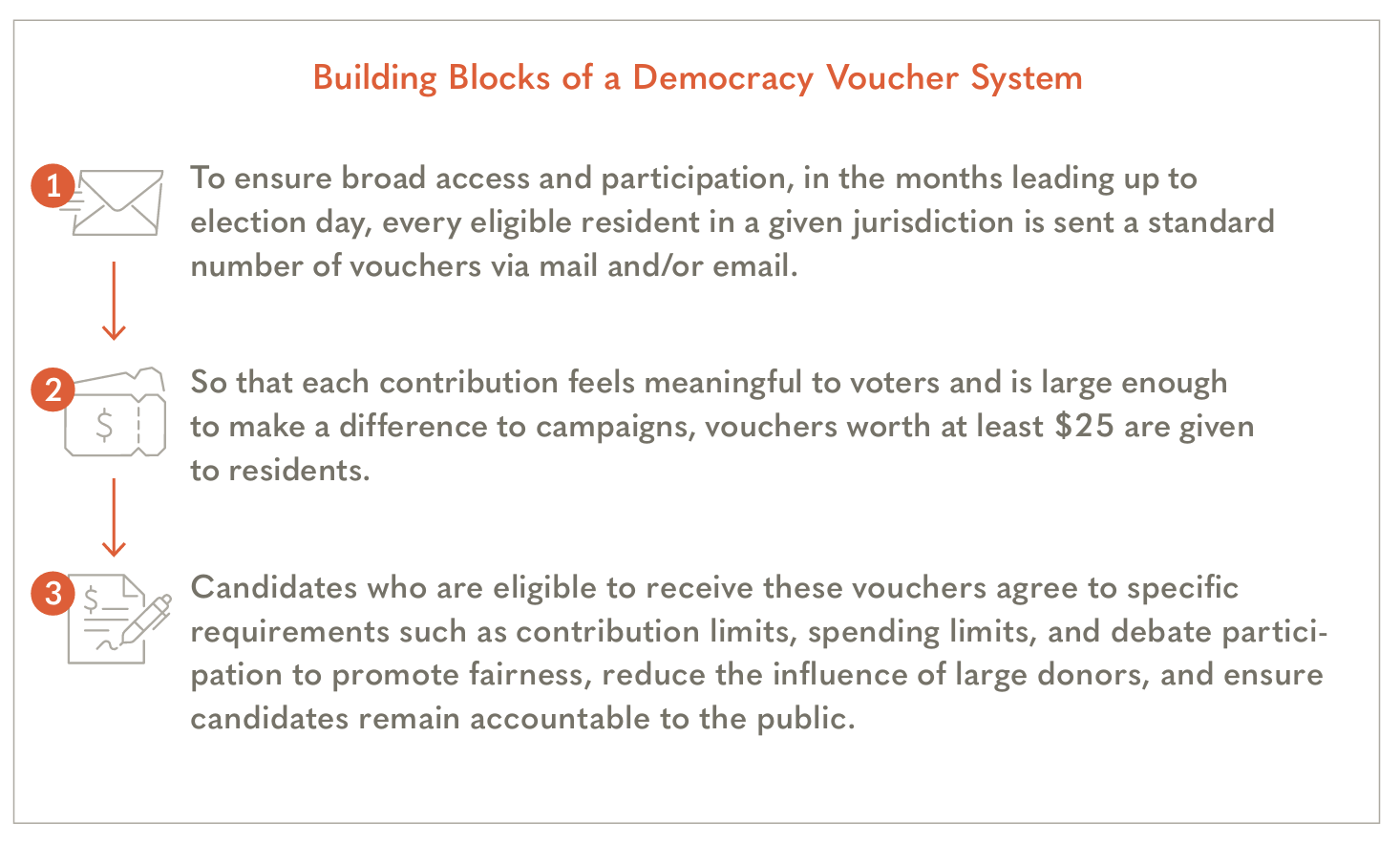
Democracy vouchers are small amounts of public funds that are made available to each eligible resident to donate to a participating candidate of their choice. They are ideally designed and implemented as follows: To ensure broad access and participation, in the months leading up to election day, every eligible resident in a given jurisdiction is sent a standard number of vouchers via mail and/or email. So that each contribution feels meaningful to voters and is large enough to make a difference to campaigns, vouchers worth at least $25 are given to residents. Candidates who are eligible to receive these vouchers agree to specific requirements such as contribution limits, spending limits, and debate participation to promote fairness, reduce the influence of large donors, and ensure candidates remain accountable to the public. In an ideal model, voucher candidates are also banned from accepting money from political action committees (PACs) and corporations (e.g., as required by the Seattle Ethics and Elections Commission) to prevent the program from being undermined by outside big-money influence.
The vouchers are sent to any resident who is ...
- 16 years of age or older, in order to engage young people early and build lifelong habits of civic participation, and
- lawfully able to donate to campaigns, including all U.S. citizens and lawful permanent residents, to ensure compliance with existing campaign finance laws and avoid legal barriers to implementation.
Distributing vouchers to this broad group encourages civic participation across demographic groups.
Legislative bodies at the local, state, and federal level can establish democracy voucher programs for all kinds of races—from city council to state governor, from House representative to the presidency.
This Solution Works for Black and Brown People
In 2021, the Seattle democracy vouchers program was shown to significantly reduce or almost eliminate the racial contribution gap.
Democracy vouchers have been shown to diversify the donor pool, giving candidates greater incentive to prioritize the needs of Black and brown Americans. In 2021, the Seattle democracy vouchers program was shown to significantly reduce or almost eliminate the racial contribution gap. This commonsense solution to the corporate capture of our democracy puts the needs and priorities of people of color onto the agenda in Washington, D.C., and state capitals across the United States. In this way, curbing the influence of big money in politics is a key part of the unfinished business of the Civil Rights Movement.
This Solution Builds Power
In a 2014 study, Baylor University political scientist Patrick Flavin examined spending priorities in various states between 1962 and 2008 and compared them with campaign finance laws. Flavin concluded that campaign finance laws do have important effects on public policy decisions that matter most for disadvantaged citizens. Specifically, when states more strictly regulate the financing of political campaigns, they tend to devote a larger portion of their spending each year to redistributive programs such as public assistance, housing, and community development.
This relationship between stricter campaign finance laws and more spending on redistributive programs holds even after accounting for differences in the ideology and partisanship of a state’s citizens and elected officials over time.
Democracy vouchers shift power away from the billionaire class.
Democracy vouchers shift power away from the billionaire class and toward Black and brown communities to meaningfully shape public policy and exercise real political power.
Resources to Learn More
- Aaron McKean and Maha Quadri, Campaign Legal Center, What Is Public Financing? How Small-Dollar Democracy Combats Big-Money Elections, August 7, 2025
- Adam Lioz, Dēmos, Stacked Deck: How the Racial Bias in Our Big Money Political System Undermines Our Democracy and Our Economy, July 23, 2015
- Laura Williamson and Adam Lioz, Dēmos, Small Donor Democracy: Fighting Big Money with People-Powered Elections, March 25, 2021
- Sean McElwee, Brian Schaffner, and Jesse Rhodes, Dēmos, Whose Voice, Whose Choice? The Distorting Influence of the Political Donor Class in Our Big Money Elections, December 8, 2016
- Dēmos and Washington CAN!, Racial Justice Advocates Provide Essential Leadership in Pioneering Seattle Democracy Vouchers Victory, August 5, 2021
Dēmos staff who can provide more information