The following is a structural solution from Dēmos' 2026 Policy Agenda, Power Policies: How to Get and Keep People Power in the United States
The Problem
Traditional voter registration systems in the U.S. put the onus on the individual to register to vote.
Voters must also consistently check and keep their registrations active, particularly in states that regularly and aggressively purge voters from their rolls. This burden is a barrier to political participation and inclusion. Moreover, the voter-initiated registration system is burdensome for election officials, who must process a deluge of registration applications in the lead-up to each election.
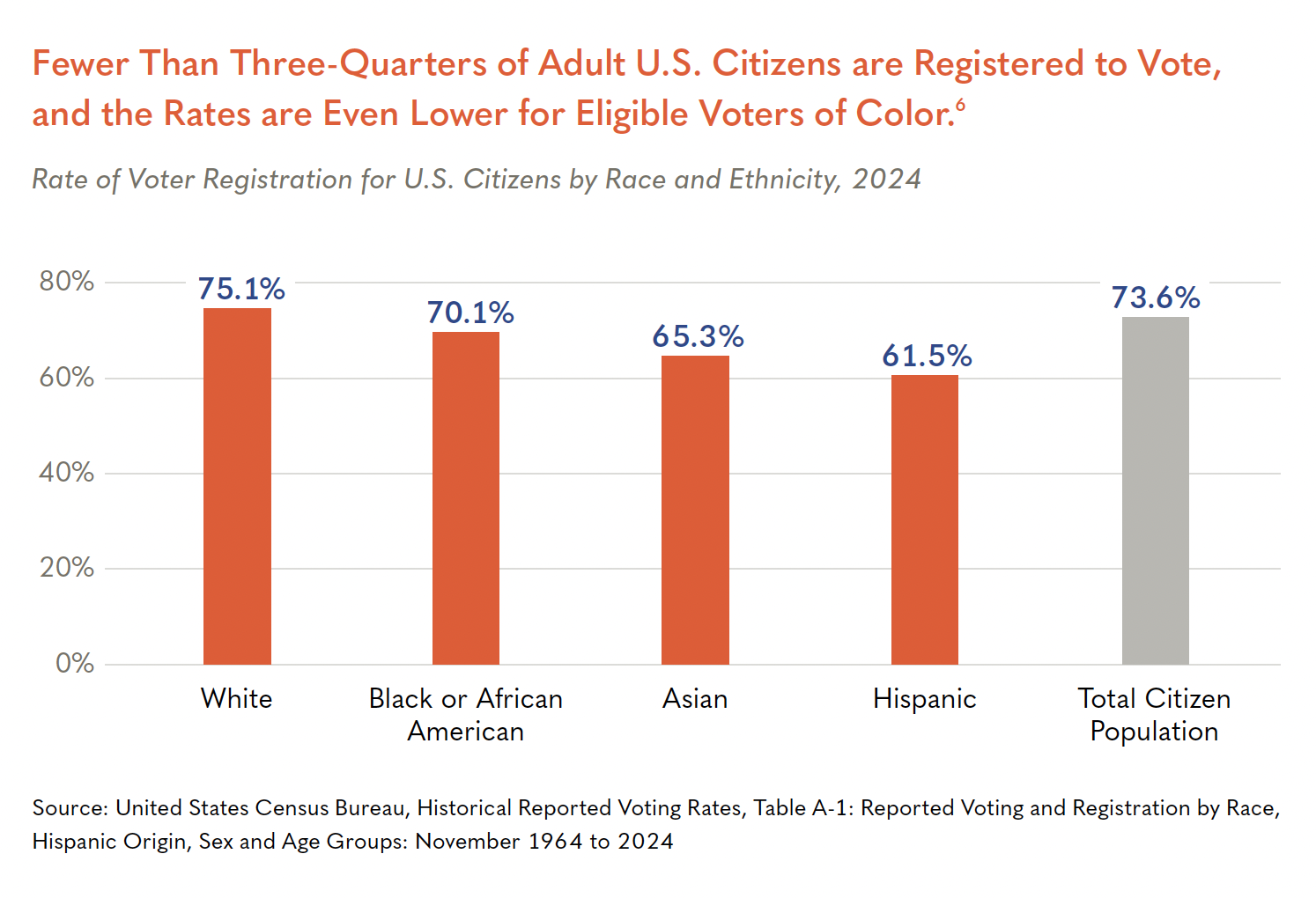
Reducing barriers for voter registration is critically important for all voters but has special significance for voters of color, due to the racist origins of voter registration laws. Voter registration was first implemented in the U.S. after the 15th Amendment granted formerly enslaved Americans the right to vote. Such laws “served – and often were intended to serve – as a means of keeping African-American, working-class, immigrant, and poor voters from the polls.” Additionally, laws that outright banned Native Americans from registering to vote were not all repealed until 1957. These structural inequities persist today: As shown in the chart below, these structural barriers mean voter registration rates for non-white racial and ethnic groups trail those of their white counterparts.
Additional figure information
There’s a Policy Solution for That
Unlike the U.S., most democracies around the world take responsibility for registering their citizens to vote through automatic voter registration (AVR).
Oregon was the first state to implement AVR in 2015; today, 10 states and Washington, D.C., have implemented the preferred method of AVR, known as “secure” AVR. Fourteen additional states have implemented a more limited form of AVR known as “partial” AVR.
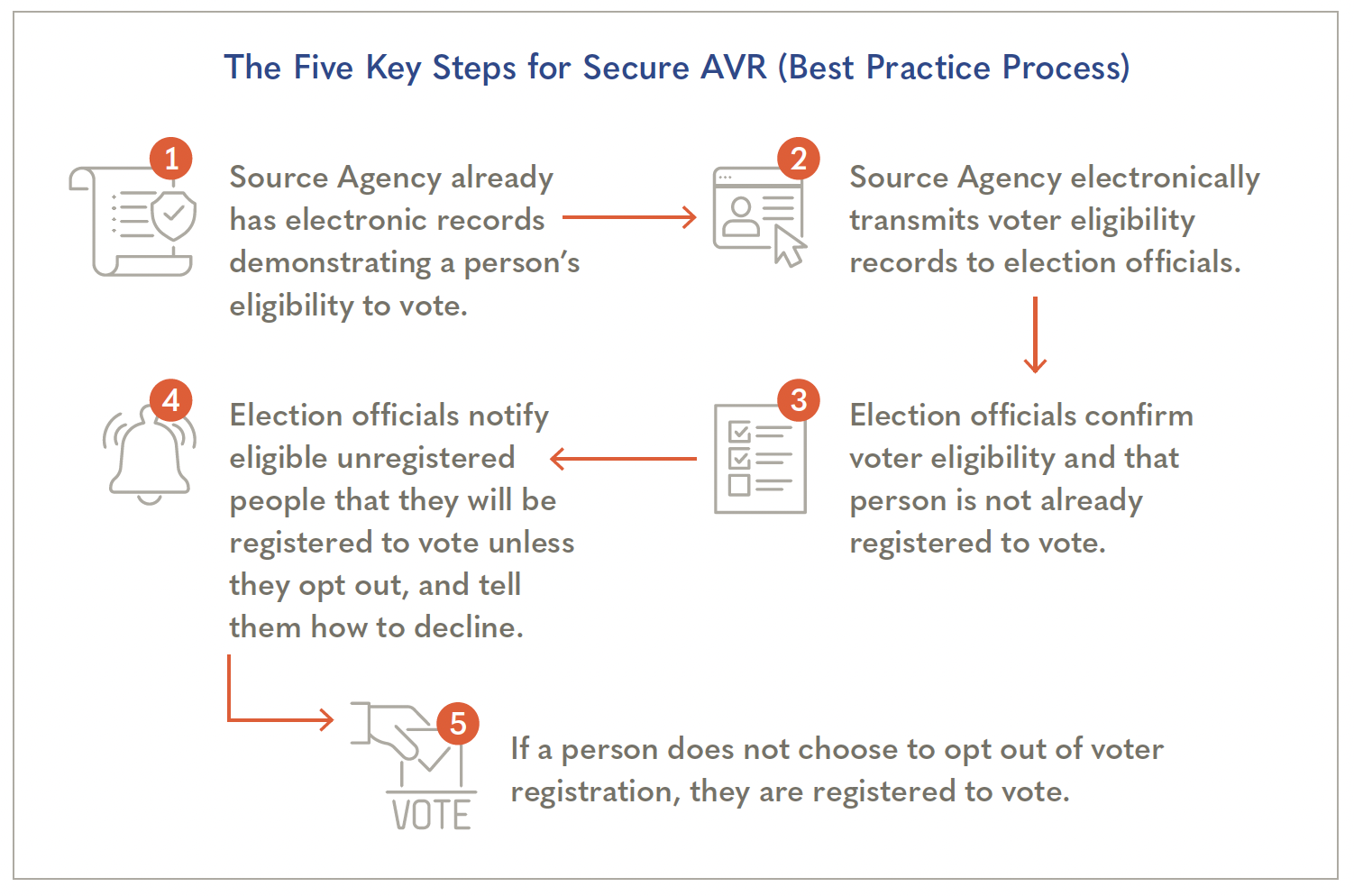
Secure AVR is implemented through public entities – such as departments of motor vehicles (DMVs), Medicaid offices, departments of corrections, and tribal nations – that regularly interact with people and routinely collect information necessary to verify voter eligibility (name, date of birth, residence, and citizenship status). Under this system, agencies directly transmit information concerning voter eligibility to election officials. Election officials then comb through the list from each agency, remove those who are already registered, and confirm eligibility of those who are unregistered. Election officials go on to notify eligible unregistered people that they will be added to the voter rolls unless they decide to opt out of registration. If the eligible voter takes no action, they are registered to vote.
To reach as many potential voters as possible, multiple agencies in each state should implement secure AVR. While DMVs are often best situated to implement AVR, that is not always the case. For example, in many states, people who have lawful immigration statuses but have not yet naturalized can get driver's licenses. They often become citizens after they have interacted with the DMV, and so the DMV records will not reflect that they are newly eligible to vote. For this reason, other entities such as Medicaid offices, tribal nations, and departments of corrections should also be included.
It is also critically important that state agencies are able to easily and securely transfer voter eligibility information to election officials. Legislation that establishes AVR systems should also ensure that infrastructure is in place to ensure data privacy and efficient data sharing.
This Solution Works for Black and Brown People
The Institute for Responsive Government has found that secure AVR consistently registers at least 95 percent of a state’s eligible population.
When implemented correctly, AVR takes the burden off individuals to continually update and check their voter registration and registers the majority of a state’s population.
Using statistical techniques to identify the impact of AVR in each implementing state, the Brennan Center for Justice found that the practice significantly increased the weekly number of new registrants anywhere between nine percent and 94 percent. When implemented correctly, AVR takes the burden off individuals to continually update and check their voter registration and registers the majority of a state’s population, which goes a long way toward counteracting the racist origin of voter registration requirements.
This Solution Builds Power
A just, inclusive multiracial democracy must reflect the voices of all eligible voters.
Simplifying and streamlining the voter registration process is a necessary step toward building political power for more voters.
Yet those who are eligible but unregistered cannot participate in our elections. Simplifying and streamlining the voter registration process is a necessary step toward building political power for more voters. Moreover, being registered to vote correlates with greater rates of voting participation among people of color, young people, and people earning low incomes. By removing the barriers to voter registration, AVR can create the conditions necessary for everyday people to build greater political power.
Resources to Learn More
- Liz Kennedy, Lew Daly, and Brenda Wright, Dēmos, Automatic Voter Registration: Finding America's Missing Voters, January 20, 2016
- Institute for Responsive Government, Automatic Voter Registration
- Kevin Morris and Peter Dunphy, Brennan Center for Justice, AVR Impact on State Voter Registration, April 11, 2019
- Allison Neswood and Sonya Schwartz, Native American Rights Fund, Four states open the door to automatic voter registration for Native Americans, August 13, 2024
- National Conference of State Legislatures, Automatic Voter Registration, Updated July 21, 2025
Dēmos staff who can provide more information