The following is a structural solution from Dēmos' 2026 Policy Agenda, Power Policies: How to Get and Keep People Power in the United States
The Problem
Redistricting, the process of redrawing the boundaries of electoral districts, is not a neutral exercise.
It has become a scramble for power, with political parties and interest groups skirting traditional timelines and practices to ensure that their preferred constituency has more representation and others have less. The deck is stacked in this scramble. A wave of recent Supreme Court decisions has resulted in serious setbacks to the federal Voting Rights Act (VRA), which protected communities of color for decades, while allowing partisan gerrymandering that divides communities to flourish.
Communities of color are especially vulnerable to vote dilution and unfair representation, with legislators given a license by the courts to engage in partisan gerrymandering as a pretext for overt racial discrimination.
As a result, communities of color are especially vulnerable to vote dilution and unfair representation, with legislators given a license by the courts to engage in partisan gerrymandering as a pretext for overt racial discrimination. We have already seen gerrymanders in Southern states before the 2026 elections and can expect even more throughout the U.S. before the 2028 elections. These gerrymanders wreak havoc on the representation of communities of color, as they are sacrificed and split between districts or packed into a single district to create partisan advantages. It is possible there will only be a handful – or even zero – majority-Black or majority-Latino districts left standing in some states. This trend will no doubt continue into 2030, when states and localities throughout the U.S. begin redistricting after the decennial census.
There’s a Policy Solution for That
States and localities can significantly improve the redistricting process by combining three key pillars of reform:
- Creating more accountability and transparency by holding redistricting meetings that are open to the public and requiring significant community input in map drawing;
- Reshaping redistricting criteria to protect racial and ethnic communities, consistent with the federal and state law, and to limit partisan gerrymandering that could divide communities for the sake of party advantages; and
- Shifting power to independent redistricting bodies such as citizen commissions that are more responsive to community input.
These reforms, working together, would make sure that the bodies responsible for drawing district lines are independent of partisan interests, promote transparency, and seriously consider community input, including the interests of voters of color.
Strong avenues for community-based input, clear redistricting criteria, and the independence of the redistricting body can all help gain fair representation for communities of color.
These reforms can also help counter further setbacks in voting rights, particularly after the recent Supreme Court ruling in Louisiana v. Callais, which limited lawsuits under Section 2 of the VRA to cases of intentional racial discrimination. The Supreme Court has acknowledged that race can be considered in redistricting, but it should not predominate. Communities of color can advocate for using race in tandem with nonracial factors such as economic commonalities, health and service needs, language usage, and media sources. Strong avenues for community-based input, clear redistricting criteria, and the independence of the redistricting body can all help gain fair representation for communities of color.
Redistricting reform packages have already been enacted in states such as California and Michigan, and over the next four years, new reforms could be enacted for the 2030 cycle. Particularly fruitful areas for reform are county- and city-level policies, which can be enacted via both state legislation and local ballot initiatives. At the federal level, proposed legislation like the Redistricting Reform Act of 2025 (H.R. 5449/S. 2885) would mandate independent commissions in all states for congressional maps and help put an end to partisan redistricting wars where states try to tip the balance of the House of Representatives and ignore the interests of communities of color.
This Solution Works for Black and Brown People
Redistricting reforms with the factors described above have already made it possible for Black and brown communities to have greater influence in drawing the maps that ultimately affect their representation.
In California, for example, reforms first enacted for the 2010 cycle have made the process far more transparent to communities of color. The reforms have prioritized consideration of communities of interest (including racial communities). And they have implemented a citizen-commission system designed to promote geographic and racial diversity in its membership.
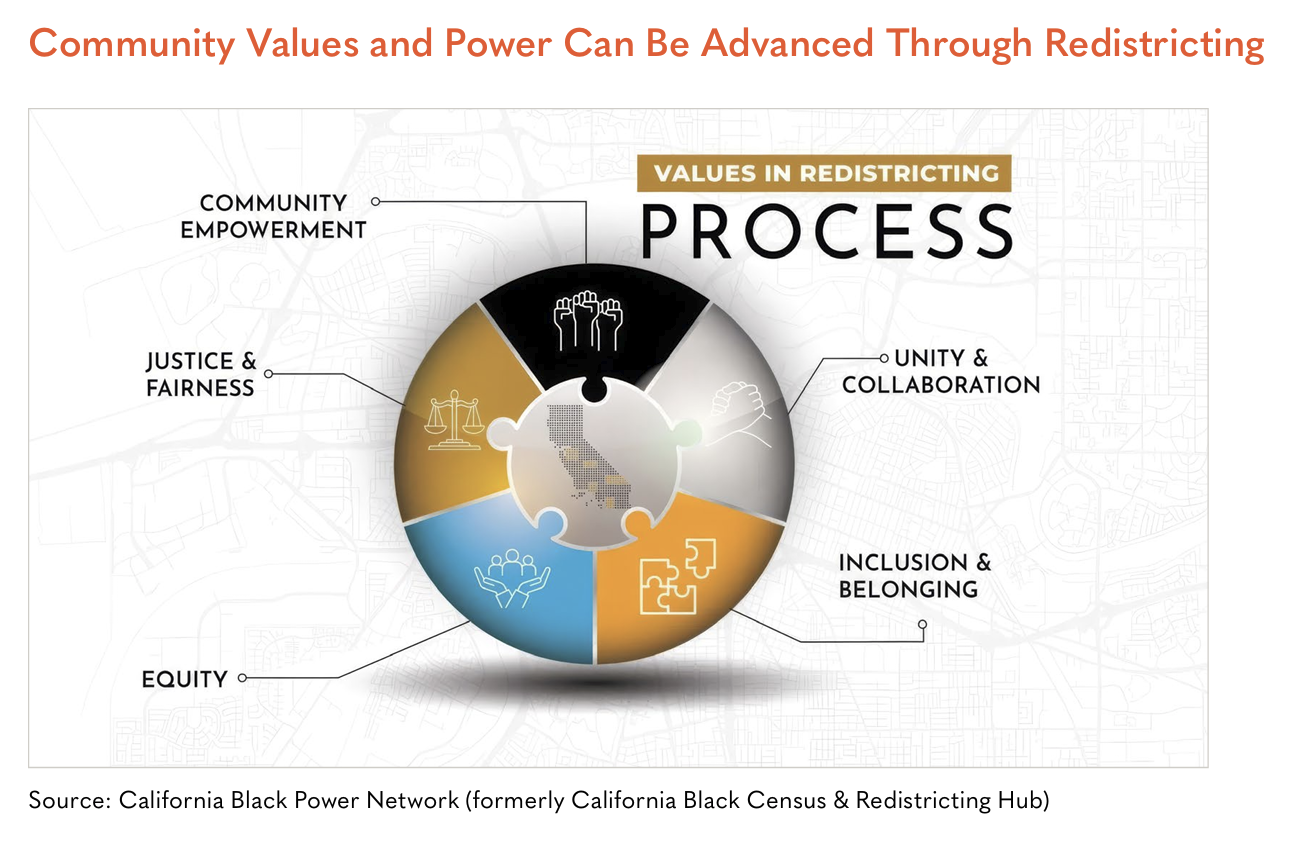
Grassroots coalition building tied to redistricting has been a key development in areas with redistricting reforms. For instance, the California Black Census and Redistricting Hub was a statewide coalition that developed multiple district maps and successfully advocated for Black communities to be kept intact throughout the state in the 2020 cycle; it has since evolved into the California Black Power Network, a 501(c)(3) organization. Comparable examples of reforms and advocacy can be found in states such as Michigan, Colorado, and Arizona, as well as in cities such as Austin, Texas.
This Solution Builds Power
Enacting these redistricting reforms will build power along several dimensions.
- A more transparent and accessible redistricting process encourages the development of grassroots advocacy aimed at improving representation, including coalitions across multiple geographies and racial/ethnic groups. And these structures can be sustained beyond the redistricting cycle.
- Black and brown membership on the redistricting body itself can improve representation and advocacy within a governmental body. As one recent report has noted, there is widespread agreement that “commissions must reflect the diversity of their constituents with lived and/or learned experience” and “commissions must ‘marry demographics, ethnic/racial representation, and political party diversity.’” California’s law, for example, requires various types of diversity on its commission, including racial, ethnic, and geographic diversity.
- The resulting district maps can preserve the voices of voters of color by keeping communities of color intact within districts—especially critical given recent court rulings that strip away traditional tools for protecting Black and brown political power. Advocacy centered on communities of interest can still produce strong minority opportunity districts, keeping these communities together rather than splitting or packing them.
Resources to Learn More
- Sarah Andre et al., Common Cause. Common Cause, Charge Report: Community Redistricting Report Card, June 11, 2024
- Justin Levitt et al., Loyola Law School, All About Redistricting: Ideas for Reform,Common Cause, California Local Redistricting Project, 2018
- Common Cause, The Roadmap for Fair Maps in 2030: A Summary of the 2023 National Citizen Redistricting Commissioners Conference, 2024
- Common Cause, Youtube Playlist: 2023 Conference on Commissions and 2030 Reforms, April 26, 2024
- Campaign Legal Center, Redistricting Commissions in the 2021 Redistricting Cycle: Case Studies And Lessons Learned For 2031 And Beyond, 2024
- Vladimir Kogan and Eric McGhee, California Journal of Politics and Policy, 4(1), Redistricting California: An Evaluation of the Citizens Commission Final Plans, February, 24, 2012
Dēmos staff who can provide more information