The following is a populist policy solution from Dēmos' 2026 Policy Agenda, Power Policies: How to Get and Keep People Power in the United States
The Problem
The racial wealth divide in the United States is growing, fueled by decades of policies and practices that have excluded Black and brown people from the opportunity to accumulate the same wealth that white people have amassed for centuries.
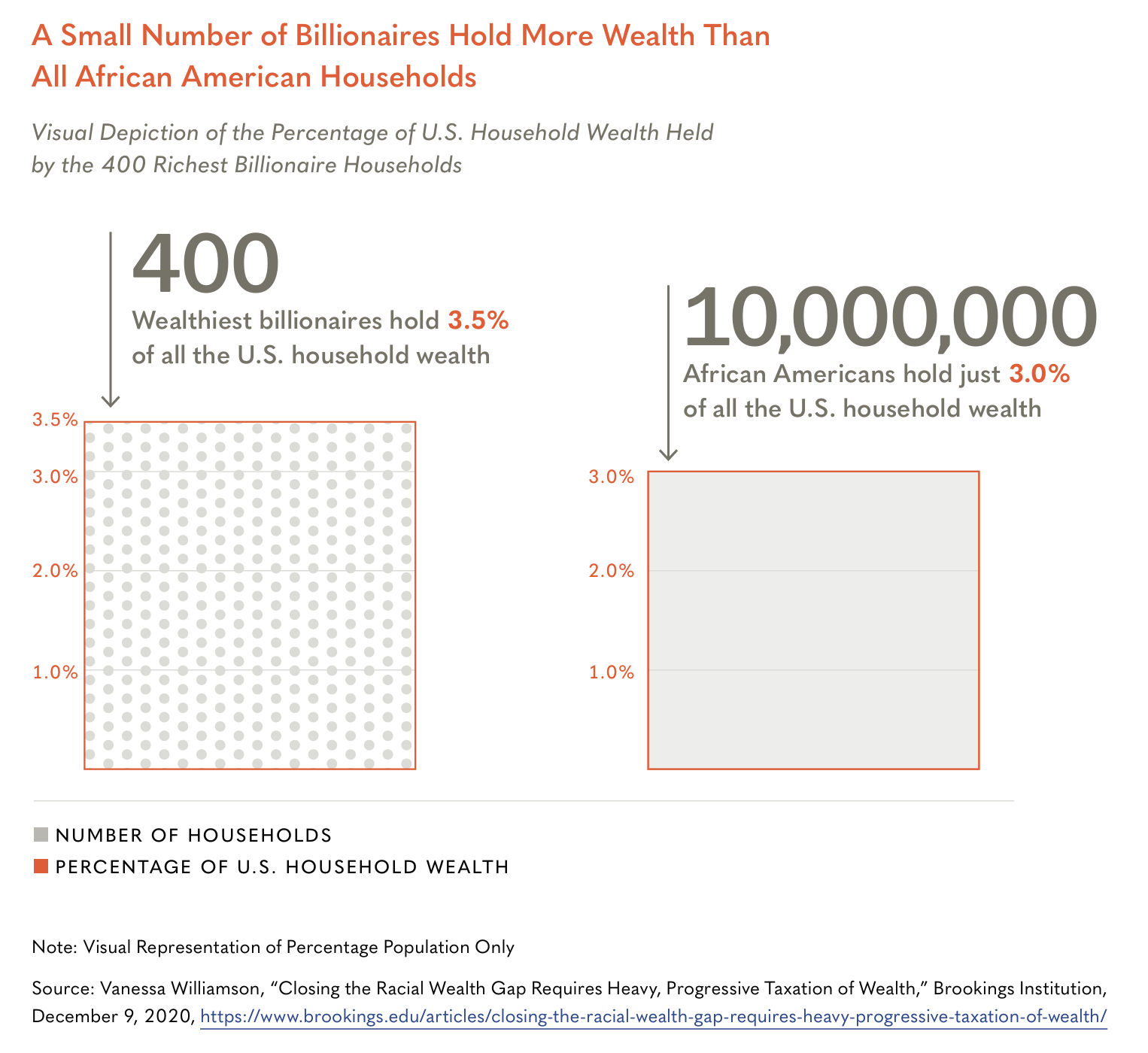
White taxpayers hold a disproportionate share of wealth in the United States and hold almost every type of wealth-bearing asset at higher rates than Black or brown households. The result is extreme inequity: In 2020, the combined wealth of America’s 400 wealthiest billionaires exceeded the total wealth held by all 10 million Black American households.
One of the core drivers of the widening divide is the tax code, which gives preferential tax treatment to wealth.
One of the core drivers of the widening divide is the tax code, which gives preferential tax treatment to wealth. This means that the tax code taxes income earned from work (like wages or a paycheck) at a higher rate than income received from wealth (like dividends or an inheritance). What’s more, the United States does not tax wealth itself.
The tax code is extremely complex. Wealthy households are able to exploit this fact, finding loopholes and strategies to avoid paying taxes. For example, ultra-wealthy households use a strategy which some call “buy, borrow, die,” in which a household purchases assets and holds on to the investments as they increase in value. Instead of selling these assets, which would trigger a capital gains tax, the holder of those assets can borrow against them and live off of those loans, which are not taxed. When the holder of the asset dies and passes on their fortune, their heirs do not have to pay taxes on the increased value of those assets, because the government now considers the current value to be the original, baseline value. The “buy, borrow, die” strategy drives extreme wealth concentration and widens the racial wealth divide.
The inequities in the tax code have far-reaching impacts. Because the United States fails to tax wealth, the ultra-wealthy have been able to exponentially grow their fortunes, leading to increased wealth concentration. This not only widens the racial wealth divide, it also undermines our democracy. Economic and political power are linked, and the increased dominance of big money in politics made possible by Citizens United has allowed the wealthy to exert power and influence over policy outcomes. This makes it harder for people of color to exert their political power and effectively advocate for their interests as both wealth and power are consolidated by a very small, very white share of the population.
Failure to tax wealth also costs the public trillions in revenue. We need this revenue to strengthen our country’s social and physical infrastructure.
There’s a Policy Solution for That
Instituting a significant wealth tax would make strides toward closing the racial wealth divide, curbing wealth hoarding, and raising trillions in revenue to pay for public goods that benefit us all.
The federal government could institute a “net-worth” tax. Such a tax would apply to the entire value of a household’s (or a trust’s) wealth, rather than targeting specific forms of wealth, such as a house, artwork, or stock holdings. A net-worth tax would include all of these things and other forms of wealth, such as businesses, and would remove the incentive for the ultra-rich to hide their wealth by converting their assets into forms of wealth that have preferential tax treatment. Households would be required to report the value of their assets when filing their taxes, similar to how households report the value of estates when reporting for the sake of an estate tax.
A recent proposal, the Make the Billionaires Pay Their Fair Share Act, would levy a five percent tax on net household wealth above $1 billion. Economists Emmanuel Saez and Gabriel Zucman estimate that this would raise $4.4 trillion in revenue over 10 years, even when factoring tax avoidance. This amount of revenue is more than 10 times the cost of free universal pre-kindergarten for all 3- and 4-year-olds.
An even more robust and equitable policy would tax households with wealth in the multimillions, not just billionaires. Such a policy should mirror the existing income tax structure, which uses graduated marginal rates, a system in which tax rates increase as income rises, with the higher rate applying only to the portion of income within a certain bracket, as shown in the table below. Using graduated marginal rates with a lower threshold, rather than imposing a flat tax on wealth above a certain high threshold, makes the tax more gradually progressive, rather than binary.
For example, under the “Make the Billionaires Pay Their Fair Share Act,” a household with $1 billion in net value would pay the tax, whereas a household with $999 million would not. A graduated marginal structure starting with a lower threshold, say $50 million, would mean that the tax would apply to more high-wealth households and avoid this “cliff effect.”
| Bracket | Marginal surtax rate |
| $50 million - $100 million | 1% |
| $100 million - $250 million | 2% |
| $250 million - $500 million | 3% |
| $500 million - $1 billion | 4% |
| + $1 billion | 5% |
To successfully implement a wealth tax, the tax must be coupled with a significant increase in IRS funding to audit and prevent tax avoidance.
Robust enforcement of this policy is essential to its success. Recently, Congress has gutted funding for the Internal Revenue Service (IRS), vastly reducing the agency’s ability to enforce the tax code. With reduced auditing power, the IRS is less able to rein in tax avoidance by wealthy households. To successfully implement a wealth tax, the tax must be coupled with a significant increase in IRS funding to audit and prevent tax avoidance.
This Solution Works for Black and Brown People
Taxing wealth would make the economy work better for everyone, and particularly for Black and brown people.
The racial wealth divide exists because the government has propped up and protected an economic system built on racial exclusion. Chattel slavery in the 18th century fueled the growth of the national economy and also boxed enslaved Black people out of those economic gains. Because wealth compounds over generations, this inequality reverberates to today and has been coupled with other racist economic policies—from redlining to failing to prevent employment discrimination to stop Black and brown people from reaping the benefits of their economic contributions.
A lasting, equitable approach to eliminating the resulting racial wealth divide will require a holistic strategy that deconcentrates wealth at the top while investing deeply in wealth-building programs and opportunities for Black and brown communities. Taxing the nation’s wealthiest households would reduce the disparity by breaking up the massive fortunes that a small number of mostly white households have accumulated.
A federal wealth tax would also raise an enormous amount of revenue that could be spent on programs and opportunities that would allow everyone to achieve economic security and mobility, and it would remove the barriers to economic security and mobility that policy choices have placed on communities of color. If Congress passed the Make the Billionaires Pay Their Fair Share Act, or similar legislation, legislators could raise $4.4 trillion in revenue. Less than half of this revenue could:
- Provide free universal pre-k and expanded access to child care – $600 billion
- Build, repair, and operate nearly two million homes affordable to the lowest-income renters – $445 billion
- Provide national, comprehensive paid family and medical leave – $325 billion
- Expand the Child Tax Credit, a form of income support that effectively reduces child poverty and allows families to invest in their futures – $310 billion
- Permanently extend coverage to low-income individuals in states that have not expanded Medicaid – $200 billion
- Make two-year community college tuition free – $90 billion
Using the tax code to distribute the nation’s abundant resources more equitably is, and should be, one of the core functions of government.
This Solution Builds Power
A robust wealth tax would make strides toward closing the wealth divide and building economic power for Black and brown communities.
A robust wealth tax would make strides toward closing the wealth divide and building economic power for Black and brown communities.
Corporations and the wealthy elite have enormous influence over the policy choices our government makes – choices that shape the quality of life for everyone. Taxing wealth would begin to diminish the economic and political power that a small group of ultra-wealthy, mostly white households have.
The enormous revenue that a wealth tax could raise is also an important step toward building economic power for Black and brown communities and creating a more equitable democracy. To actualize that power, the federal government must use that revenue to fund programs that support economic mobility, particularly targeted so that Black and brown communities can build the kind of wealth that white families have for centuries.
Resources to Learn More
- Greg Leiserson, Will McGrew, and Raksha Kopparam, Washington Center for Equitable Growth, Net Worth Taxes: What They Are and How They Work, March 21, 2019
- Vanessa Williamson, Brookings Institute, Closing the Racial Wealth Gap Requires Heavy, Progressive Taxation of Wealth, December 9, 2020
- Erica Williams, DC Fiscal Policy Institute, DC Can Raise $121 Million or More with a Simple Tax on Proceeds from Wealth, February 24, 2026
- Sen. Bernie Sanders and Rep. Ro Khanna, Make Billionaires Pay Their Fair Share Act, March 2, 2026
Dēmos staff who can provide more information