The following is a populist policy solution from Dēmos' 2026 Policy Agenda, Power Policies: How to Get and Keep People Power in the United States
The Problem
Housing costs have soared in recent years, leaving renters spending an unaffordable share of their income to remain housed.
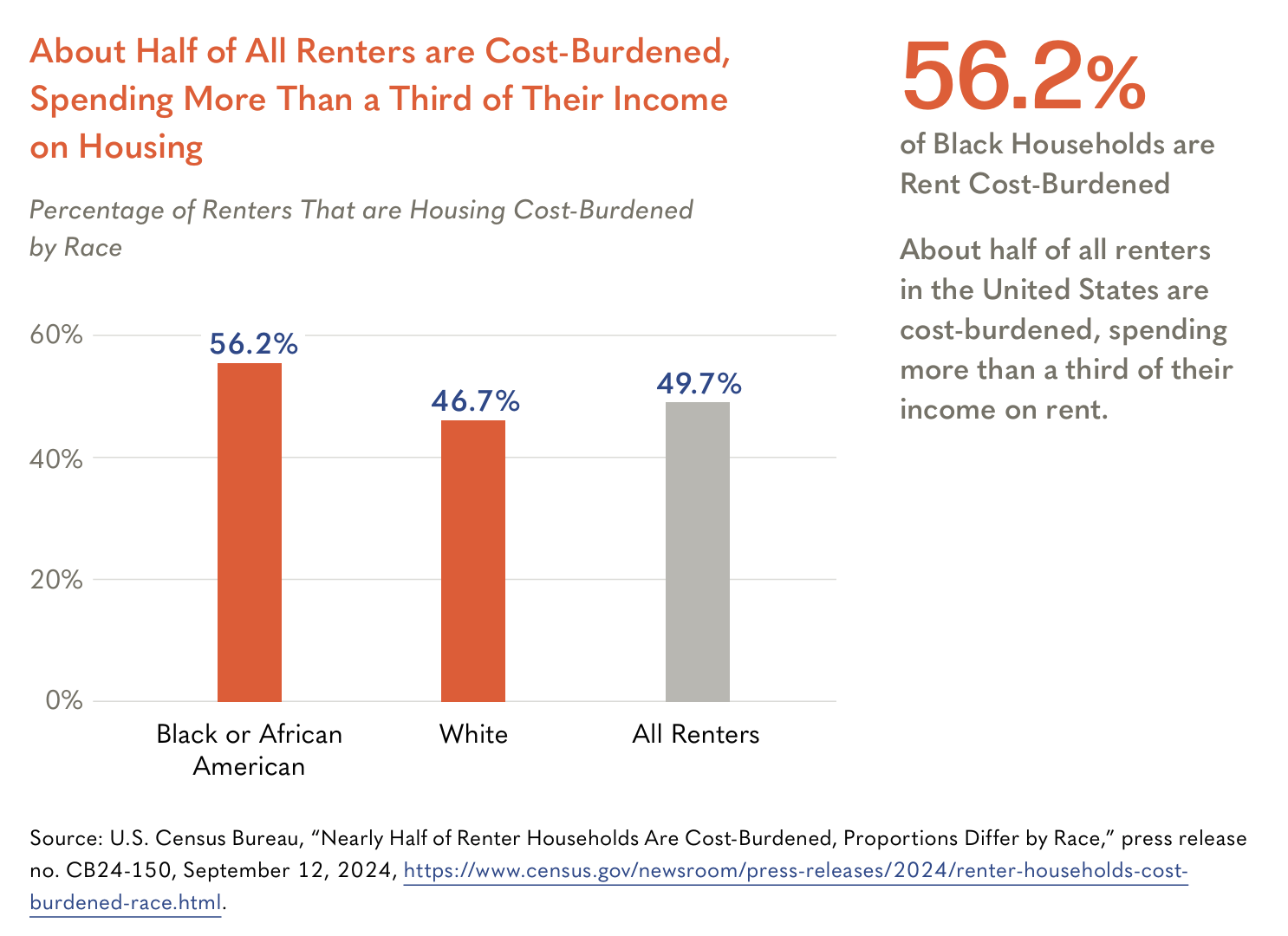
About half of households in the United States who rent their homes are cost-burdened, meaning they spend more than a third of their income on rent. Black households, who face even more overlapping barriers to economic security as a direct result of racist policies and practices, have an even higher rate of housing cost burden, at 56.2 percent.
Housing costs are so high, and rising, because the private housing market (the primary supplier of housing in the United States) has failed to provide enough housing that is located where people need it and is priced at a level they can afford. This is not a surprise: The private market will never on its own provide housing at scale that is affordable to households with low or moderate incomes. This is because the system for financing production or preservation relies on the assumption that housing costs will increase over time.
Building and preserving housing are expensive endeavors, so developers require an infusion of capital from outside lenders to cover acquisition, materials, labor, developer fees, and more. In the current system, these lenders are frequently private equity investors who expect a return on their investment. For the project financing to pencil out, developers and lenders must incorporate rent increases into the financing equations. Because the private system for housing financing must eventually guarantee profit, prices for consumers will inevitably rise.
While the government does invest billions of dollars a year in housing, the vast majority of those dollars go to forms of subsidy that have been ineffective and insufficient.
The government has over-relied on this private, profit-driven model to provide rental housing, failing to intervene in the market in ways that actually protect housing stability for people. While the government does invest billions of dollars a year in housing, the vast majority of those dollars go to forms of subsidy that have been ineffective and insufficient.
There’s a Policy Solution for That
The federal government can use public dollars to create a large-scale public financing program that invests directly in the creation and preservation of permanently affordable rental housing. The creation and maintenance of adequate rental housing stock to meet the needs of families and individuals will require a structural intervention in the housing market that fundamentally changes the equation so that affordability, not profit, is the central priority. Only the federal government has the resources and the reach to intervene at the scale required.
The high cost of construction is one of the main drivers of rising rents and is therefore the main barrier to overcome when crafting an affordable housing strategy. Many states and Washington, D.C., already have programs that offer grants or very low-cost loans that drastically reduce construction costs. For example, D.C.’s program, the Housing Production Trust Fund, supported the creation of 9,000 affordable units. But the scale of the funding need is far beyond what D.C. or any other state could fund on their own.
The federal government can employ its unique ability to dedicate resources at the magnitude necessary to bring down the cost of rental housing and already has mechanisms that it could use to make this possible.
The federal government can employ its unique ability to dedicate resources at the magnitude necessary to bring down the cost of rental housing and already has mechanisms that it could use to make this possible. The Housing Trust Fund (HTF), for example, allocates funds to states to subsidize affordable housing for people experiencing homelessness, people with disabilities, and the elderly. The HTF is funded through dedicated contributions from Fannie Mae and Freddie Mac, two government-sponsored enterprises (GSEs), not through annual congressional appropriations and therefore less vulnerable to cuts from partisan funding fights.
By using the Housing Trust Fund (or a similar program modeled after it) and expanding its funding and scope, the federal government can meaningfully bring down the rent costs that are eating up family budgets. To accomplish this, it should:
- Dedicate adequate funding from a stable revenue source that is not dependent on the wild swings in the housing market, as GSEs are. Lawmakers could use revenue from a tax on wealth, a strengthened estate tax, or a surtax on incomes over $1 million, which could raise billions of dollars in additional revenue.
- Expand the scope and eligibility criteria of the current Housing Trust Fund. Currently, states are required to use funds from the HTF to support housing for households with extremely low incomes. For the HTF to bring down the cost of housing at the scale that the U.S. needs, the federal government should raise the income limits significantly, allowing the HTF to fund housing for households with low, or even moderate, incomes.
- Ensure that the fund still reaches those most in need. While overall eligibility requirements should be expanded to meet overall need, to ensure that households with very low incomes continue to be served, the HTF should require that states set aside funds for housing affordable to households with extremely low incomes.
- Require permanent affordability. The Housing Trust Fund requires that rental projects receiving funding maintain affordability for 30 years, and either 10, 20, or 30 years for homeownership projects, depending on the level of investment. To ensure that housing funded through public funds continues to benefit the public, affordability requirements should be permanent, not time-limited.
- Retain part-ownership of housing. In exchange for contribution of public funds, the government can use something called “public equity retention” to maintain part-ownership of the housing receiving the funding. This ownership stake not only allows the government to preserve affordability requirements, it also lowers, or entirely eliminates, the need for a significant return on investment that private lenders or owners would require.
This program could also allow the government to retain some equity ownership in the buildings that receive this public financing. This would be an even more robust way to preserve the long-term affordability of new and rehabilitated housing.
This Solution Works for Black and Brown People
As housing costs rise across the country, families are struggling to keep up. This is particularly true for Black, brown, and Indigenous households, because discriminatory practices and policies have excluded them from the generational wealth and economic opportunity that have enabled many white families to access stable, high-quality housing. Job discrimination, wage suppression, and exclusionary housing policies have left Black and brown households with overall lower median incomes and significantly less wealth than their white counterparts. This means that Black and brown families are much more likely to experience housing insecurity and are less able to weather sudden rental cost increases.
If the federal government commits to providing low-cost public financing at the scale necessary, with adequate affordability restrictions and oversight, it could not only bring down the cost of housing for everyone but also make the housing market more equitable. The first and most direct way it would do this is by simply increasing the amount of genuinely affordable housing.
A massive infusion of public dollars into the housing market in this way would decouple housing production from a very volatile housing market that is increasingly subject to the interests of billionaires and private equity. Shifting the market actors so that the federal government is the major investor in rental housing stock in the U.S. rather than private equity, we can change the experience of Black and brown renters. By diminishing the control that profit-driven developers and landlords have in the housing market, we can interrupt their patterns of extracting these resources from Black and brown communities.
More robust public investment and oversight in the housing market would diminish the power that private equity has amassed to the detriment of Black and brown communities.
This Solution Builds Power
Creating a substantial program that provides adequate low-cost public financing to lower the cost of housing would make a tangible difference in everyone’s day-to-day lives, but the impact would be felt especially by Black and brown communities. This proposed solution would help everyone grow their economic power and contribute to closing a longstanding racial wealth divide. It would do this by diminishing the amount of financial control that corporations have over the housing market, including where housing is built and who can afford to live in it.
Significant, direct public investment and oversight in the housing market represents a significant shift in market forces. When government takes on a stronger role as an active, accountable agent, it challenges the private actors whose profits have depended on keeping housing costs high and excluding Black and brown communities.
Not only does this solution reduce economic power for corporations, it increases the economic power of Black and brown families. Rigorous oversight would help reduce discrimination, which has long been a barrier for Black and brown communities in accessing stable housing and wealth-building opportunities.
With lower housing costs and fewer discriminatory barriers, Black and brown families will have more agency over their homes and neighborhoods. With more ability to choose where they want to live, including the ability to withstand displacement pressures, Black and brown families can invest more time and resources in their own communities and avoid the negative effects of displacement. When families are not spending an untenable portion of their paychecks on staying housed, they have more resources available to invest in other aspects of their own economic security and mobility.
Resources to Learn More
- U.S. Department of Housing and Urban Development, Housing Trust Fund
- National Low Income Housing Coalition, National Housing Trust Fund Project
- Will Viederman and Daria Guzzo, NYU Furman Center, What Policymakers Need to Know About New and Evolving Publicly-Driven Housing Development Models in the U.S., October 3, 2024
- Paul Williams et al., National Housing Crisis Network, Mixed-Income Public Development Model: Local Housing Finance Agency Innovation
- Groundwork Collaborative, We Can’t Deregulate our Way to Housing Affordability: New Report Reveals Rents Won’t Decrease Until We Fix Housing Finance, March 25, 2026
- Chuck Collins, Omar Ocampo, and Amee Chew, Institute for Policy Studies, Billionaire Blowback on Housing, October 21, 2024
Dēmos staff who can provide more information