The following is a structural solution from Dēmos' 2026 Policy Agenda, Power Policies: How to Get and Keep People Power in the United States
The Problem
The racial wealth divide is widening, and our current financial system actively deepens inequities that worsen the divide. Commercial banks—including the ones municipal and state governments rely on to hold public dollars—are structured to serve shareholders rather than the public. They charge governments steep fees and interest that drain money away from public goods like affordable housing, and they invest public deposits in harmful industries rather than back into the communities those dollars came from. The result is a system that extracts wealth from communities, with disproportionate harm to Black and brown neighborhoods, while enriching corporate shareholders.
When you renew your car registration, pay a traffic ticket, register your small business, or file your taxes, the money you pay your state or local government becomes a public fund. These funds are used by state and local governments to run programs, but before that money is spent, it sits in a private bank. And that bank invests public funds in harmful industries such as private prisons and fossil fuels to generate high returns that line their shareholders’ pockets. The public sees none of these profits, even though it was public funds that generated them.
How Using Private Banks for Public Needs Profits Shareholders and Costs the Public: An Example
- The county doesn't have enough money upfront to build affordable housing, so it borrows from a commercial bank.
- The bank charges interest on the loan, and over time, the county pays back far more than it borrowed.
- To make those interest payments, the county uses public dollars raised from everyday people through taxes, fees, and fines.
- The bank's shareholders profit at the public's expense.
- The county gets its housing but at a much higher price.
- In the end, there is less money for child care, schools, and other community needs.
Local governments spend $160 billion on interest payments to commercial banks each year.
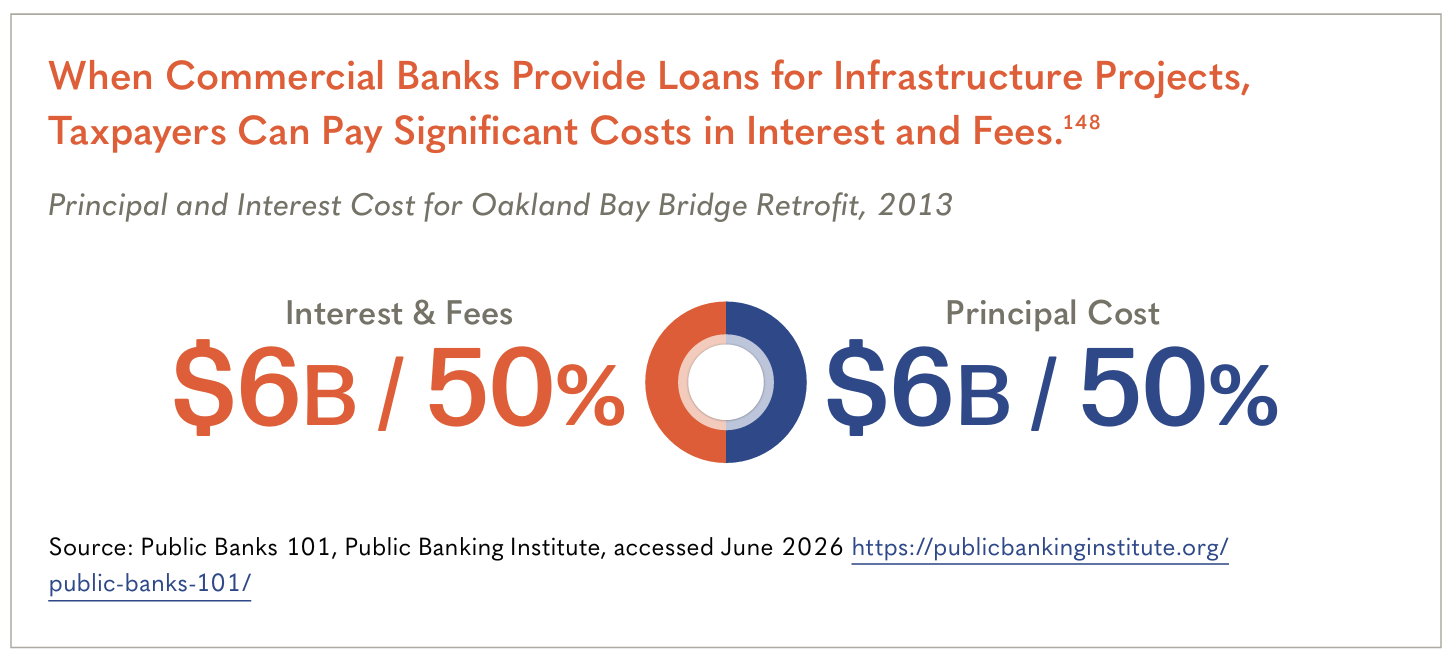
Local governments spend $160 billion on interest payments to commercial banks each year. In some cases, the cost of infrastructure projects doubled due to the interest on loans. The Bay Bridge Retrofit in Oakland, California, for example, cost $6 billion in interest, nearly the same amount as the principal loan. Cash-strapped school districts in California have relied on capital appreciation bonds—an expensive form of long-term debt—just to build classrooms. For the Santa Ana Unified School District, this means taxpayers will have to pay $340 million to settle a $35 million debt. In addition to high interest rates to borrow money, governments also pay banking fees on their depository accounts to hold and manage public funds.
There’s a Policy Solution for That
State and local governments can intervene in this extractive system by establishing public banks—financial institutions owned by the people and operated for the public good. Public banks give governments control over their own money, so public dollars build housing, schools, and infrastructure at a fraction of the cost instead of padding shareholder returns. By leveraging their own deposits, public banks can finance public projects at lower costs, expand access to credit for local businesses and developers, and respond more directly to local economic needs through partnerships with local financial institutions.
Implementation of public banks begins at the state or municipal level through legislation that establishes a public bank, defines its governance structure, and sets clear public-interest mandates. When established, the day-to-day activities of a public bank are run by skilled banking professionals who ensure compliance, while a board of elected officials, community members, and public stakeholders ensures the bank and its activities are responsive to the needs of the community.
The federal government can play a key role in increasing the number of public banks in the United States by passing a bill that explicitly authorizes states and localities to establish public banks, removes legal barriers and threats of preemption, provides grants and technical support to help launch them, and grants access to Federal Reserve services. Federal legislation can create a clear pathway for broader adoption of public banking and enable communities to retain control over their public funds.
This Solution Works for Black and Brown People
Well-structured public banks would allow municipalities and states to expand access to fair banking and build wealth in Black and brown communities, all while investing public funds in ways that advance the public interest.
Beyond expanding access to equitable financial services such as affordable loans for small-business owners, public banks can invest savings and profits back into the communities they serve. The public bank of North Dakota—the only public bank in the United States—has returned over $1 billion to the state general fund, and over the past 35 years, two-thirds of its profits have gone back to the state, on average. Feasibility studies in cities across the country show what this could look like elsewhere. A New York economic impact study concluded that $6.5 billion in deposits could generate $1.1 billion in investments in climate solutions, 17,855 units of affordable housing, 70,600 local jobs, and $5.8 billion in loans to Black and brown communities in just five years. In Massachusetts, researchers project that a public bank could lend $1.3 billion at sustainable interest rates to close local credit shortfalls. In Los Angeles, an interactive balance sheet simulator shows that $100 million of deposits could build or preserve 17,000 housing units and generate enough green energy to power 2.8 million average U.S. homes a year over 10 years.
By delivering economic stability and creating visible, community-centered pathways for public investment, public banks can also strengthen democratic engagement. When people feel like they have a voice in the government’s decisions and are satisfied with public services, they are more likely to trust the government and participate in civic processes. In this way, public banking is not just an economic tool but also a mechanism for deepening democratic inclusion and political power.
This Solution Builds Power
Public banks can directly expand Black and brown communities’ economic and political power by shifting both who makes financial decisions and who benefits from them.
Public banks can directly expand Black and brown communities’ economic and political power by shifting both who makes financial decisions and who benefits from them. The choices a bank makes—who gets a loan, what gets built, which industries get funded, which neighborhoods get capital—shape the daily lives of us all and have historically harmed Black and brown communities the most. By including community representatives on governing boards, public banks put those choices in the hands of the people most affected by them, creating formal roles for residents to shape how public dollars get invested. This shared governance gives Black and brown communities real power over the economic decisions that determine whether their neighborhoods are invested in or left behind.
At the same time, public banks operate at cost, which allows them to reduce fees and offer lower interest rates. Instead of generating profits for private shareholders, they reinvest earnings back into communities. Governments can redirect savings from reduced interest payments and fees toward affordable housing, small business lending, infrastructure, and job creation in Black and brown neighborhoods.
Public banks keep wealth circulating locally. They expand access to capital, support long-term asset building, and create more-stable economic conditions. As communities gain a voice in financial decisions and see resources flow back into their neighborhoods, they build the kind of lasting economic and political power that the current banking system has long denied them. Public banking is more than a policy fix—it's a tool for redistributing power, repairing harm, and reimagining whom our financial system is built to serve.
Resources to Learn More
- Dēmos, New Economy Project, Public Banks for Racial Equity, Democratizing Finance to Build Community Wealth, May 20, 2025
- Public Banking Institute, Public Banks 101, January 31, 2019
- Dēmos, New Economy Project, Public Bank NYC, Banking for the Public Good: Public Bank NYC, May 26, 2022
- California Public Banking Alliance, Public Banking: Mechanics, Funding, Sustainability, Benefits, and Risk Management, April 2025
- Adem Sengal, Trinity Tran, and Sean Gonsalves, The Forge, Lessons From Fights For Public Control of Banking and Broadband Infrastructure, April 20, 2026
- Terri Friedline and Sarah Treuhaft, City & State New York, Opinion: Public Banks Offer an Opportunity to Reclaim Local Power and Build Inclusive Economies, July 18, 2025
Dēmos staff who can provide more information