
Image

We examine the persistent racial divide in women's unemployment, what's driving it, and how policymakers can address the structural conditions that limit Black women’s ability to thrive.
The state of the economy was the top issue in the midterms, and one of the most watched measures of economic health is headline job growth. Since December 2024, women have accounted for nearly all of it, largely because the few jobs that are being added are concentrated in industries where women make up most of the workforce.
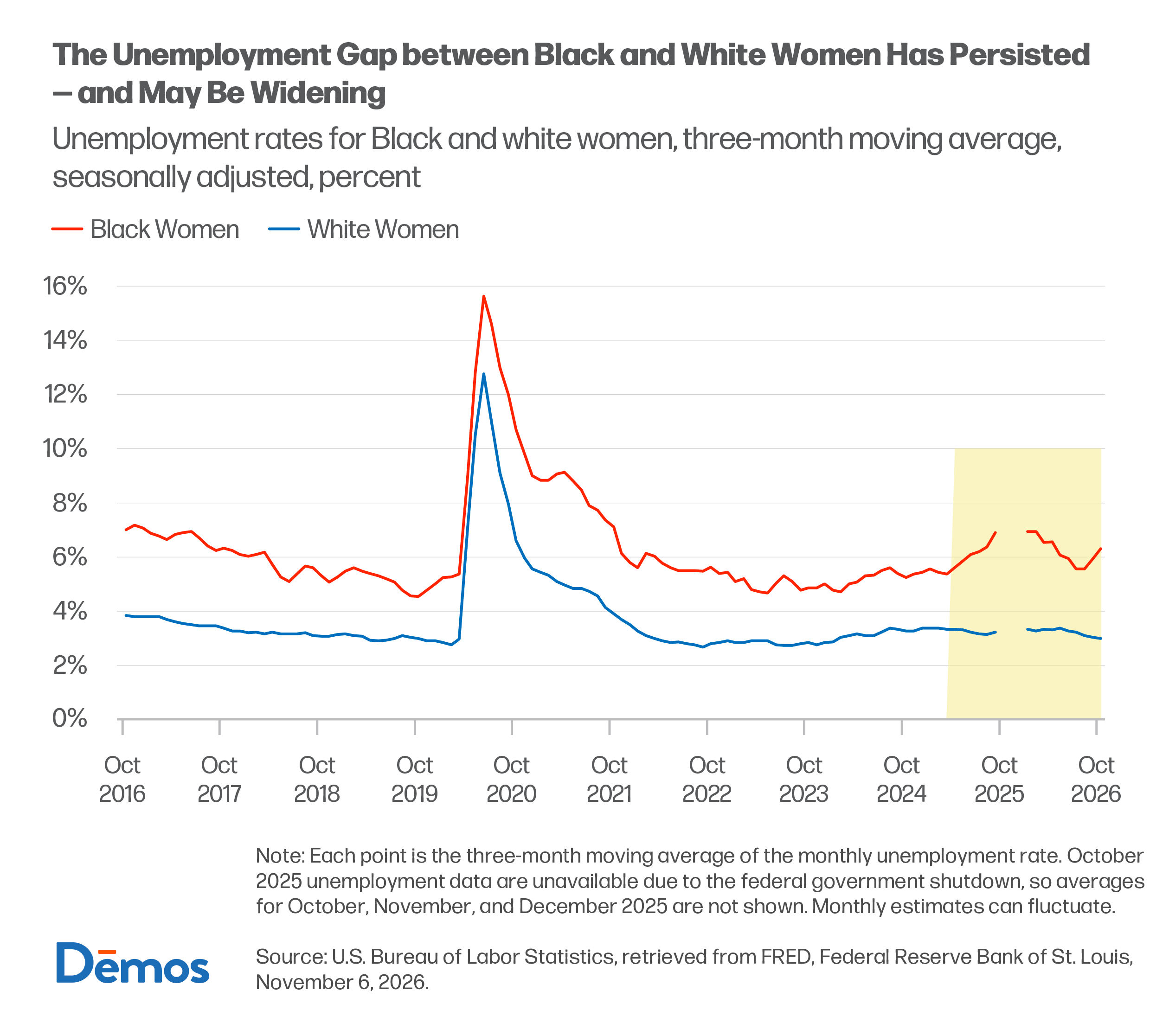
Black women continue to face higher unemployment than white women
But that news is less positive than it sounds, because there isn't much growth to claim. Employers added about 1.46 million jobs in 2024 but only about 181,000 in 2025. October's gain of 165,000 jobs beat expectations, making for a solid month for job growth, though overall growth in 2026 has been modest. And not all women are benefiting equally. Black women continue to face higher unemployment than white women, and that divide appears to have widened since President Trump returned to office. These disparities underscore why we must look beyond overall job growth to understand who has access to employment opportunities and who is being left behind.
Since December 2024, the number of payroll jobs held by women has grown by a net 809,000, far outpacing men.1 Much of the job growth experienced by women has occurred within women-dominated industries, such as health care and social assistance. In October, these industries added 55,100 jobs, a key contributor to last month’s net job growth of 165,000. As I've written before, job growth alone doesn't tell us whether people are better off. The types and quality of jobs being created matter too.
Women's overall employment gains also obscure persistent racial disparities and say little about whether women who want work are actually finding jobs. The unemployment rate, the share of people actively looking for work who can't find it, offers a clearer picture. Black women continue to face roughly double the unemployment rate of white women, and that divide appears to have widened since President Trump returned to office (though monthly estimates can fluctuate). In the latest jobs report, the unemployment rate for Black women ticked down to 6.5 percent but remains more than double the rate for white women (3.1 percent). This disparity highlights how headline job growth can obscure unequal experiences across race.
Part of the answer lies in longstanding structural barriers and systemic racism in the labor market. Discrimination in labor markets can limit Black women's access to jobs and affect hiring decisions. Occupational segregation also means that Black women are disproportionately concentrated in lower-paying jobs, which often have less stability and fewer benefits.
Public-sector job losses, mostly in the federal government, have been especially damaging for Black women. In 2025, for example, Black women gained about 222,000 jobs in educational and health services, but public-sector job losses, driven largely by the Trump Administration’s cuts to the federal workforce, more than erased those gains, leaving them with a net loss of about 79,000. Government jobs have long been one of the most reliable pathways for Black women, offering higher pay and more job security than the private sector typically does for workers with similar education and experience. The pattern of decline in government work has continued in 2026, with a loss of 45,000 federal government jobs in 2026 so far. Recent reporting has also pointed to federal government job cuts and the rollback of DEI efforts as potential contributors to worsening outcomes for Black workers overall.
An economy adding jobs isn't necessarily an economy creating equitable opportunities.
An economy adding jobs isn't necessarily an economy creating equitable opportunities. To understand whether the labor market is working for working people and families, we must look beyond how many jobs are added and ask where jobs are added, where they're disappearing, and who has a fair chance of finding work. As a new Congress takes shape, policymakers must focus not only on creating jobs but on ensuring that workers, and Black women in particular, have access to the work they want and dismantling the structural barriers that limit Black women's ability to thrive in the labor market.
Author's calculations of the change in nonfarm payroll employment for women and men, December 2024 to October 2026.

