Image

If we want to build an economy that works for everyone, we must focus not only on how many jobs are created, but also on strengthening worker power and advancing policies that improve job quality—especially in undervalued sectors.
Last month's jobs report showed slower than expected job growth, raising questions about the strength of our labor market. But whether job growth is strong or weak in any given month, headline numbers tell only part of the story. What matters isn't just how many jobs are being added but what types of jobs they are and whether they provide real economic security for workers.
We’re seeing more jobs in fields known for long hours and relatively low pay, and fewer jobs in sectors that offer workers the wages, benefits, and stability they need to thrive.
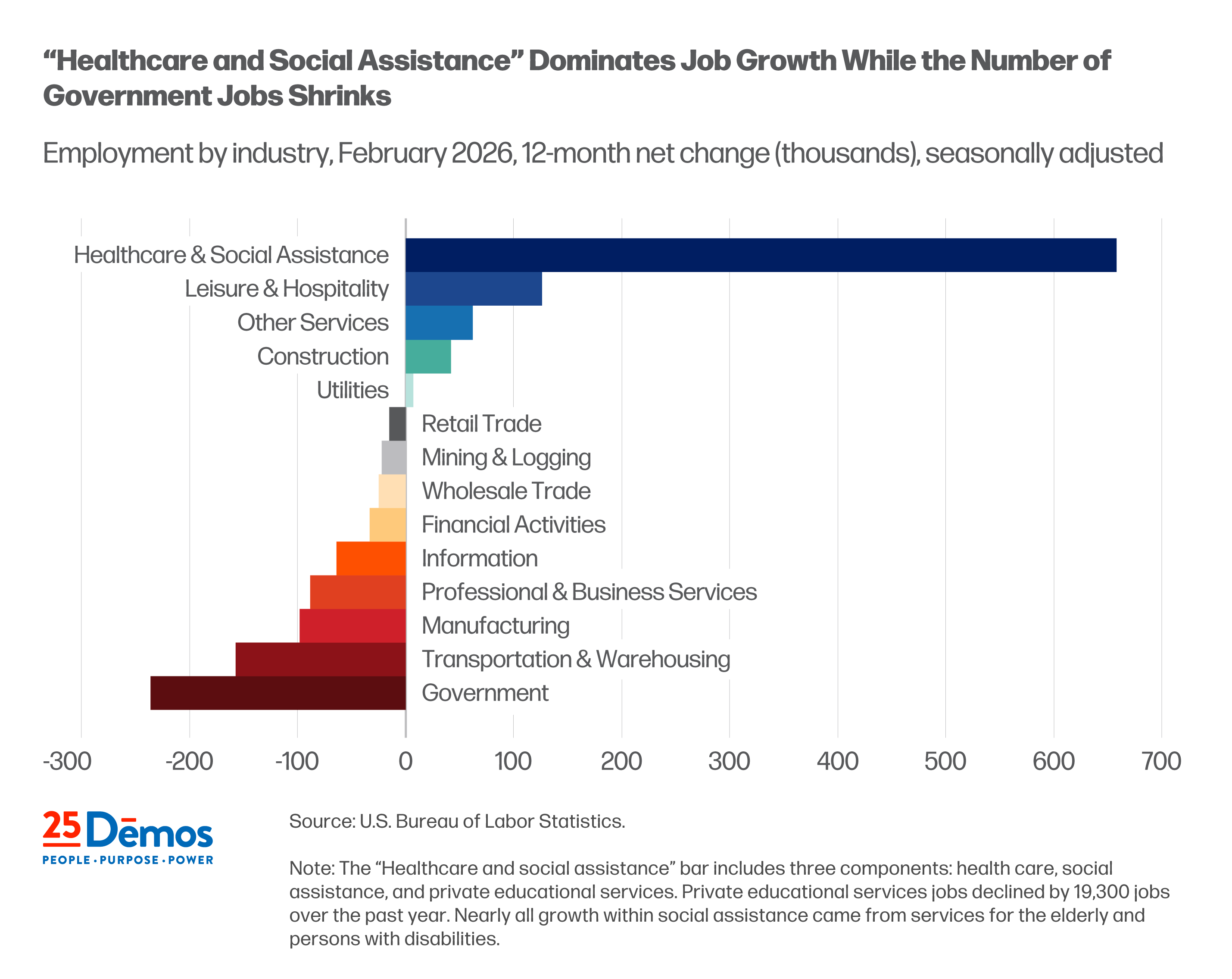
Over the past year, 658,000 jobs were added in the health care and social assistance industry, and 236,000 jobs were lost in the government industry. In short, we’re seeing more jobs in fields known for long hours and relatively low pay, and fewer jobs in sectors that offer workers the wages, benefits, and stability they need to thrive.
Despite a dip last month, partly reflecting temporary factors like striking workers, health care and social assistance still accounted for a disproportionate share of overall job growth over the past 12 months. Although essential to helping people survive and thrive, many health care and social assistance occupations remain on the lower end of the earnings distribution. This is especially true for roles like home health and personal care aides, jobs that are essential to patient care but pay significantly less than the median wage across the economy. Many of these positions lack strong benefits or stable schedules, even as demand for care work is expected to grow in the coming years.
If the health care and social assistance fields continue to drive employment gains, policymakers must ensure those jobs actually provide stability and dignity for workers. Today, many of these jobs remain underpaid and insecure, reflecting the consequences of past policy choices. For decades, care work has been undervalued in policy decisions, from weak labor standards to limited public investment in the care workforce. Black and brown women bear the brunt of these policy failures because they make up more than half of the direct care workforce.
As low-wage work in health care and social assistance is expanding, another sector that has historically provided economic stability—jobs with stable, family-sustaining pay, benefits and reliable schedules—is shrinking: federal employment. The Trump administration has erased hundreds of thousands of federal government jobs since January 2025. Government jobs have historically provided one of the most reliable pathways to economic security for Black workers, especially for Black women who are overrepresented in federal government jobs. Layoffs in this sector have broader implications for economic stability across the workforce, with particularly disproportionate impacts on economic stability for Black workers.
Policy choices play a critical role in shaping job quality, especially in the care economy. Wage standards, labor protections, and public investment in this sector all influence how these jobs are structured and compensated. For example, Minnesota recently created a Nursing Home Workforce Standards Board that brings together workers, government, and employers to set labor standards and minimum wages. Policies like this can raise wages and improve working conditions in care jobs by giving workers a voice in setting the standards that affect their pay, schedules, and safety.
Low wages in care work are not inevitable, nor are service-sector jobs inherently less valuable than other jobs.
The point is, low wages in care work are not inevitable, nor are service-sector jobs inherently less valuable than other jobs. Job quality is heavily shaped by worker power, not necessarily by the nature of the work itself. Manufacturing jobs, often cited as examples of "good jobs," became well compensated only after decades of organizing and unionization efforts that raised labor standards. We can see similar dynamics playing out in the health care and social assistance industry today. For example, recent organizing efforts by nurses in New York City led to pay increases and stronger protections after a 41-day-long strike. Studies have shown that unionization leads to higher wages for direct care workers across the whole sector. Collective action can improve wages and working conditions in care occupations, just as it did historically in other sectors.
As care work makes up a growing share of employment in the U.S., policymakers must ensure that these jobs provide real economic security. That means making policy choices that raise wages, strengthen labor standards, and expand worker power for care workers and the people in other undervalued sectors of the economy. Otherwise, strong job numbers may continue to mask deep and persistent economic inequities.