Image

The unemployment rate for Latina women reminds us that access to work alone is not enough. An economy that works for all requires jobs that provide security, safety, and real opportunity.
An economy can create jobs without delivering security, and for Latina women, that disconnect is especially clear. Even as employment among Latina women has reached historic highs, they continue to face higher unemployment rates than other groups and are concentrated in jobs that leave them economically vulnerable. These realities rarely show up in headlines but shape how many Latina women in the U.S. experience the labor market.
The latest jobs report came in better than expected, and once again, headlines zeroed in on the topline unemployment rate and job growth numbers as evidence of economic strength. But these figures should be interpreted with caution. Significant downward revisions to last year's jobs numbers are a reminder that headline numbers alone can overstate how well the economy is actually working.
Even if these numbers are accurate, they mask persistently high unemployment rates and economic insecurity for one of the fastest-growing groups in the U.S. labor market: Latina women.
This month, our blog asks two important questions: Do Latina women 1 have access to jobs in this economy? And are these jobs delivering real economic security?
The answers to both questions remain concerning. The data show Latina women continue to face elevated unemployment rates compared to their non-Hispanic white counterparts, and when they are working, they are often concentrated in low-wage jobs that leave them especially vulnerable to economic shocks.
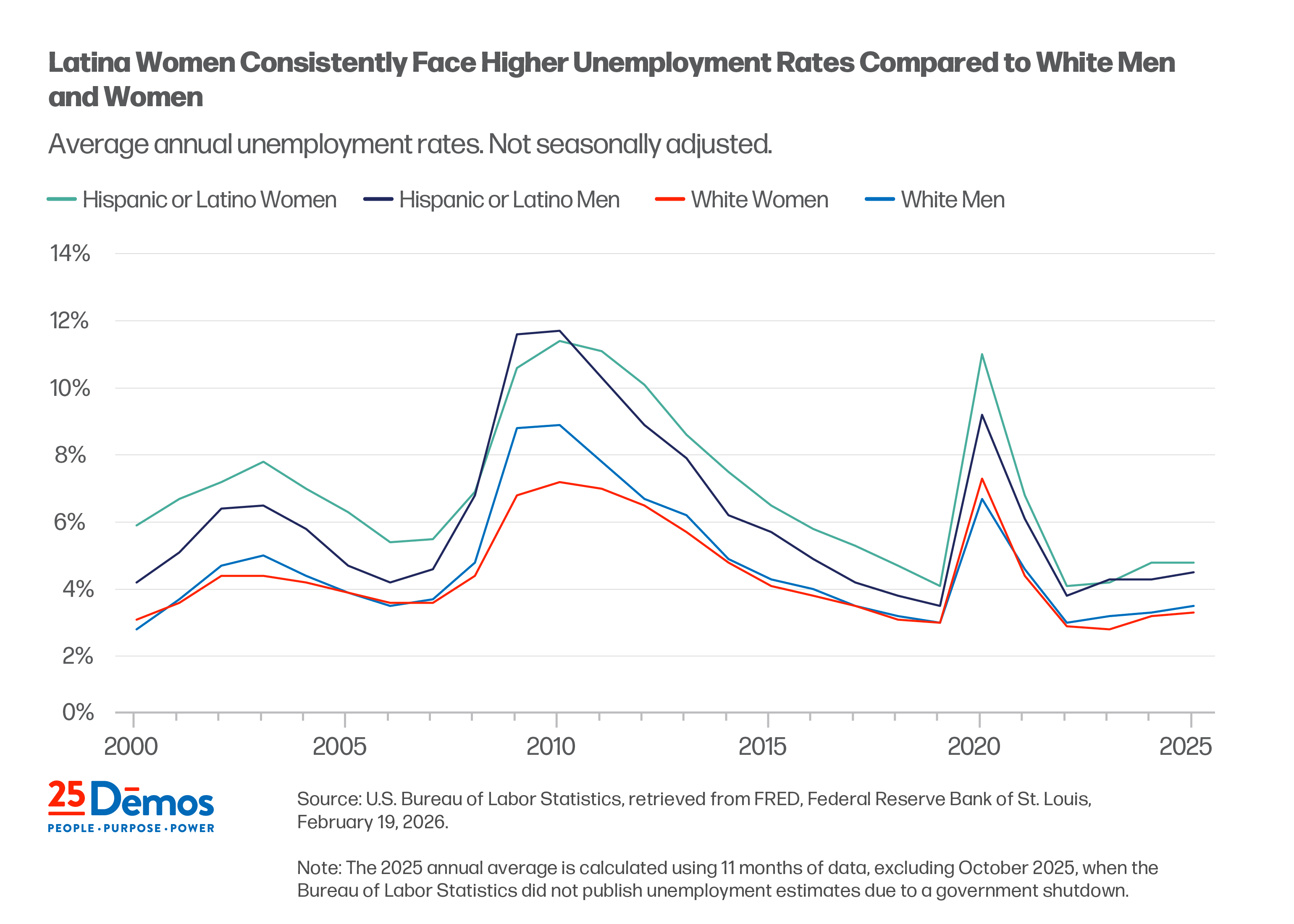
Latina women consistently experience higher unemployment than non-Hispanic white women and men—and often Latino men as well.
Viewed over time and across groups, Latina women's unemployment reflects a persistent and troubling pattern. As the chart below shows, Latina women consistently experience higher unemployment than non-Hispanic white women and men—and often Latino men as well.
Unemployment data suggests that job access for Latina women remains uneven at best. The latest data from the Bureau of Labor Statistics (BLS) show that the unemployment rate for Hispanic or Latina women increased from 4.5 percent in December 2025 to 4.7 percent in January 2026. And while their non-Hispanic white female counterparts also saw an increase (from 3.2 percent to 3.4 percent), the levels of their respective unemployment rates betray a sharp disparity: In January, non-Hispanic white women's unemployment rates were 1.3 percentage points lower than the 4.7 percent rate for Hispanic or Latina women.
Despite making up just 9 percent of the U.S. population, Latina women drove 30 percent of labor force growth between 2010 and 2021.
Latina women are one of the fastest-growing groups in the U.S. workforce. Despite making up just 9 percent of the U.S. population, Latina women drove 30 percent of labor force growth between 2010 and 2021. But even while Latina women are experiencing record high employment that has contributed meaningfully to overall economic growth, their unemployment rates remain higher than many other groups, highlighting that a growing number of Latina women face job insecurity in the labor market.
Official data may understate the true extent of Latina labor force participation, given evidence that undocumented people are undercounted in population surveys. This matters because a significant share of the Hispanic or Latino population in the United States is foreign born. While foreign-born status does not imply that one is undocumented, more than 1 in 4 immigrant workers were unauthorized as of 2023, 27 percent of foreign-born workers are undocumented, and this group is less likely to be fully captured in the official data.
In addition to the ability to find jobs, job quality also matters. Access to any job is not the same as access to a good job, and for many Latina women, employment continues to come with low pay, instability, and a lack of protections.
One factor shaping job quality for Latina women is occupational segregation, defined as "the overrepresentation or underrepresentation of a demographic group in a certain occupation or field." Latina women are disproportionately employed in low-wage sectors. These jobs are essential to the functioning of the economy but are also more likely to offer irregular schedules, weak workplace protections, and low pay.
Latina women face the largest pay divide of any group of women in the labor market
In fact, Latina women face the largest pay divide of any group of women in the labor market, reflecting not differences in effort or skill but systematic disparities in how work is valued and compensated. If progress continues at the rate it has over the last two decades, Latina women won't be able to close the earnings gap with white men until 2178. Latina women also disproportionately shoulder unpaid care work, which can have economic costs, including limiting job opportunities.
Discrimination and bias in the workplace, including unequal treatment in hiring, pay, and promotion based on race, ethnicity, or gender, continue to limit Latina women's access to higher-paying and more-secure jobs.
Immigration policy is another key structural driver shaping job quality and economic security for Latina women. About one-third of Hispanic or Latino people in the U.S. are foreign-born, and immigration status can limit access to better jobs, legal protections, and public benefits. Aggressive immigration enforcement not only affects undocumented workers, it also creates a broader climate of fear that influences employment decisions and workers' willingness to report unsafe or abusive workplace conditions. In short, when workers are exceedingly vulnerable, employers have even greater leverage to underpay and overwork them.
Headline numbers do not capture how people experience the economy in their everyday lives. An economy can generate jobs without delivering economic stability for everyone. For Latina women, working does not necessarily mean being protected from economic insecurity, unsafe or abusive workplaces, or the constant threat of job loss.
As we (and others) have written, Latina women are not the only group experiencing a tough labor market. Persistent and large divides in unemployment rates and in job quality are not accidents. They are the result of policy choices that restrict access to good jobs for people of color, including institutional practices that allow discrimination and occupational segregation to persist while intentionally establishing weak labor protections, low wages, and the criminalization of immigrants.
Building an inclusive economy requires reimagining our norms and institutions. It means focusing on a different set of priorities. It means ending violent and destabilizing immigration policies that undermine job stability. It means strengthening worker power through higher labor standards, fair pay, and robust enforcement, especially in the sectors where Latina women are concentrated.
If we want to understand whether the economy is truly strong, we have to look beyond the headlines and ask who is still being left behind even when the numbers look good. The unemployment rate for Latina women reminds us that access to work alone is not enough. An economy that works for all requires not just jobs but jobs that provide security, safety, and real opportunity.