Introduction
Language assistance is essential to ensure that voters who lack English proficiency can participate fully in our democracy.
Since the federal Voting Rights Act (VRA) was amended to include language assistance provisions in 1975, many voters throughout the country have had access to translated election materials and interpreter services. This assistance has led to higher rates of voter registration and voter turnout in many communities.
However, the federal VRA does not guarantee language access to all voters who might need assistance. Tens of thousands of limited-English-proficient (LEP) voters fall outside of the federal VRA’s reach because of the law’s strict population thresholds and because of its limited definitions of “language minorities” who are eligible for assistance. In recent years, many state and local governments have responded to these gaps by enacting their own language access policies, including state-level voting rights acts and local ordinances focusing on large LEP populations.
Read about Michigan's language access & local voting policies
Arabic-language assistance is not mandated under federal law, and state-level voting rights legislation has yet to be enacted in Michigan as of this writing.
Some of the most recent local efforts have revolved around providing Arabic language assistance in the metropolitan area of Detroit, Michigan, which has among the highest concentrations of Arab Americans in the United States. Despite years of advocacy to include Arab Americans among the language groups covered by the federal VRA, Arabic-language assistance is not mandated under federal law, and state-level voting rights legislation has yet to be enacted in Michigan as of this writing. The Detroit-area cities of Dearborn and Hamtramck each enacted policies in 2022 to address the needs of these LEP populations and to bridge significant gaps in federal and state coverage.
Download this full Michigan case study
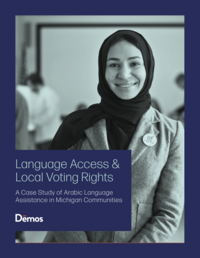
This study examines how local policies can be an effective response to major limitations of the federal VRA, how community-based advocacy can support the passage of language-access laws, and how challenges to the implementation of local policies can be overcome. There is no one-size-fits-all approach to gaining local language access policies, but this study will use the policies in Dearborn and Hamtramck to illuminate some of the more effective practices that can be applied in future language access advocacy campaigns.