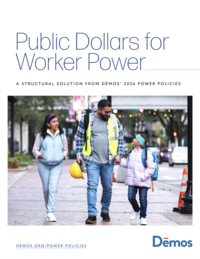
The following is a structural solution from Dēmos' 2026 Policy Agenda, Power Policies: How to Get and Keep People Power in the United States
The Problem
State and local governments funnel more than a trillion dollars to contractors every year—and too often, contractors use those dollars in ways that harm workers.
Over the past several decades, policy choices at the federal and state levels have systematically eroded workers’ ability to organize and build collective power. Weak labor laws, aggressive employer opposition, and the spread of anti-union policies have made it increasingly difficult for workers to unionize or negotiate for better wages and conditions, and economic inequality has grown. This is even more pronounced in Southern states where conservative policymakers have interfered with the ability of local governments to protect workers with policies such as minimum wage increases and paid sick day requirements. For workers, this has meant stagnant wages, rampant wage theft, dropping unionization rates, and worse health and safety outcomes.
There’s a Policy Solution for That
State and local governments can adopt worker-centered policies that raise job quality and build collective worker power by tying worker-centered requirements to the public funds they distribute to private contractors.
Across the country, state and local governments spend $1.3 trillion in public funds on public procurement annually, and their procurement and contracting policies shape labor markets and regional industries. Too often, these dollars flow to contractors that rely on low-wage, precarious employment models. Rather than counteracting the decline in economic security for workers, the contracting decisions of state and local governments create a race to the bottom. When government entities with significant purchasing power prioritize lower costs over compliance with labor standards, they incentivize bidders to cut labor costs by paying lower wages, cutting corners on safety measures, providing fewer benefits, and eliminating the ability of workers to demand or negotiate for better conditions that might increase costs. This suppresses worker power and leads to precarious work.
State and local governments’ procurement and contracting policies shape labor markets and regional industries.
While most people don’t think of procurement policy as a channel through which workers can exert power and improve their working conditions (strikes, boycotts, and contract negotiations are more typical), it has something in common with these other tools. By hitting companies where it hurts—at the profit margins—effective worker-centered procurement policy can set up a dynamic where companies that want to stay profitable have no other choice but to improve working conditions.
The purchasing power of state and local governments is vast, and it has steadily grown over time in proportion to federal spending—state and local governments account for more than 70 percent of all public spending on infrastructure. Individual county and city governments often allocate hundreds of millions—and sometimes billions—of dollars in contracts in a given year, amounts large enough to anchor local economies and shape certain industries, such as construction and janitorial work. When state and local governments are the ones channeling this money to private-sector businesses through contracting, they have the power to set the requirements associated with receiving funds. They can use that purchasing authority to set and enforce higher standards for the wages and working conditions of funded contractors.
There are two key components to an effective worker-centered procurement policy: (1) setting high-road standards through government contracts and (2) attaching strong enforcement mechanisms to those standards that empower the local government or workers themselves to hold contractors accountable when receiving public funding.
Some examples of high-road standards include:
Standards matter only if they can be enforced. To ensure compliance, an effective policy should embed clear and functional enforcement mechanisms into government contracts. This could include:
- Contract-based consequences: If a contractor fails to comply with high-road standards, the government entity could withhold payment until violations are remedied, terminate the contract, or bar a contractor from bidding on future contracts. (These consequences are already often a part of worker protections in federal contracts and could easily be adapted for state or local government contracts.)
- Requiring Project Labor Agreements (PLAs) or Labor Peace Agreements (LPAs): These types of agreements, when not preempted, effectively position labor unions to negotiate and enforce agreements regarding workers’ rights on publicly funded projects.
- Private rights of action: While less common, it is possible to use government contracts to create a private right of action for workers, which would allow them to sue directly to enforce specific standards. Provided that this right also includes the ability to claim attorneys fees if a worker is successful (as does a recently passed policy in Harris County, TX), this has the added benefit of complementing public enforcement and addressing compliance resource gaps.
These standards and enforcement policies can be implemented at the local, state, and federal levels of government. State and local governments are well positioned to incubate these policies before scaling them up. Widespread adoption of these policies at the state and local level can create momentum for adoption at the federal level later.
This Solution Works for Black and Brown People
Public spending has historically excluded or underpaid Black and brown workers, but high-road worker-centered procurement offers a direct pathway to address these inequities. Targeted and local hiring requirements can ensure that historically marginalized groups, such as Black and brown workers and women, gain meaningful access to publicly funded jobs. Higher wage and benefit standards disproportionately benefit Black and brown workers, who are overrepresented in the low-wage sectors frequently supported by government contracts.
Strong anti-retaliation protections and enforcement mechanisms are also essential, as workers of color are more likely to experience workplace exploitation and face barriers to reporting violations.
Strong anti-retaliation protections and enforcement mechanisms are also essential, as workers of color are more likely to experience workplace exploitation and face barriers to reporting violations. By tying public dollars to standards that address racial equity, governments can help reduce racial wage gaps, expand access to stable employment, and improve job quality in communities that have long been excluded from the full benefits of public investment.
This is an especially important strategy to pursue at the local government level in the South, because it offers workers and Black and brown communities a policy vehicle to reroute the flow of public dollars to build power for more equitable outcomes. Because these protections and enforcement powers are established through government contracts, instead of through broadly applicable laws, this strategy has already proven particularly resilient in the face of abusive state preemption laws in the South.
This Solution Builds Power
Worker-centered procurement builds long-term economic strength for workers and communities by raising wages, expanding benefits, and promoting stable employment. Leveraging public dollars to create strong protections and enforcement mechanisms ensures that workers can safely assert their rights, helping to expand workplace voice and support organizing efforts. At the same time, conditioning public contracts on labor standards shifts market incentives, encouraging firms to compete on quality rather than low wages and reducing race-to-the-bottom dynamics. This can even improve wages and conditions for workers who are not on government contracts. By ensuring public spending does not erode standards in the private market, these policies can also help safeguard worker power and spread higher standards across entire industries.
Resources to learn more
- Nick Wertsch, Dēmos, Building Worker Power With Public Funding at the State and Local Levels, January 16, 2025
- Terri Gerstein and LiJia Gong, Fordham Urban Law Journal, Vol. 51, No. 4 (2024), How Local Government Can Protect Workers’ Rights Even When States Do Not Want Them To: Opportunities for Local Creativity and Persistence Despite Double Preemption
- Karla Walter, Center for American Policy, Government on Workers’ Side: How State and Local Policymakers and Advocates Can Raise Standards for Publicly Supported Work, January 31, 2024
Dēmos staff who can provide more information