Image

In our latest analysis, we look beyond the headline unemployment rate to examine declining labor force participation, with particular attention to Black women, whose participation has fallen sharply in recent months.
The latest data from the Bureau of Labor Statistics shows that the unemployment rate fell slightly to 4.1 percent in July. Someone glancing quickly at the headline might assume that falling unemployment means rising hiring. But falling unemployment rates can also mean that more people are exiting the labor force altogether.
Black women have historically had relatively high rates of participation, making their recent decline worth examining.
This distinction is especially important when we look at Black women, whose labor force participation and unemployment rate have both declined in recent months. Black women have historically had relatively high rates of participation, making their recent decline worth examining.
The falling unemployment rate doesn't tell the whole story. Overall labor force participation is declining, meaning fewer people are working or looking for work, and Black women have experienced a particularly steep decline. Their experience shows us why we need to look beyond the headline numbers to understand how the labor market is working (and for whom).
So, what does a falling unemployment rate actually tell us? To understand what's happening beneath the headline, it helps to look at how the unemployment rate is calculated.
Think of a group of 100 people in the labor force. If five of them are unemployed, the unemployment rate is 5 percent. Now imagine one of those unemployed people stops looking for work and leaves the labor force. There are now 99 people in the labor force, but only 4 are unemployed. The unemployment rate falls to around 4 percent even though no one got a job.
The labor force includes people who are either working or actively looking for work. Everyone else is considered to be outside the labor force. The labor force participation rate (LFPR) measures the share of the civilian population that is working or actively looking for work.
When people stop looking for work, they are no longer counted as unemployed. Instead, they move out of the labor force. That's why looking at the LFPR alongside the unemployment rate can give us a fuller picture of the labor market.
While the headline unemployment rate ticked down, the overall labor force fell by 264,000 people.
Last month's data offered a clear example of why this matters. While the headline unemployment rate ticked down, the overall labor force fell by 264,000 people. The decline in the unemployment rate can't be understood as simply more people finding jobs. It also reflects people leaving the labor force.
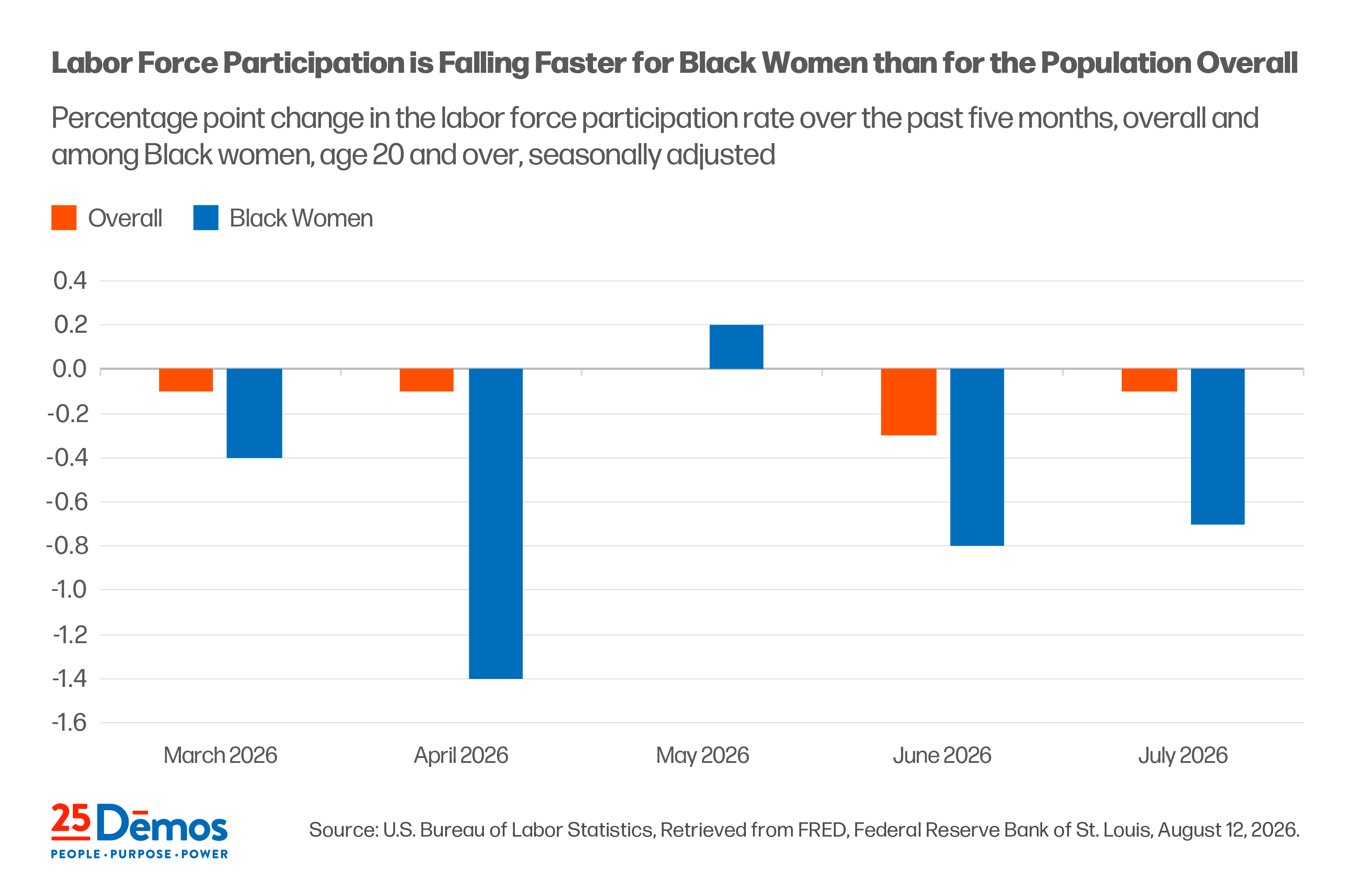
And this isn't just a one-month shift. Overall labor force participation has been trending down since September of 2024. But that decline has not been experienced equally across groups.
More broadly, Black women's labor market outcomes can provide an important lens for understanding trends in our economy. The Black Women Best framework recognizes that when Black women are able to thrive in the economy, everyone does better. Because Black women are concentrated in many of the industries that keep our economy running, gains in wages, protections, and working conditions benefit everyone, while their exclusion signals deeper failures in our economic system.
Black women's labor force participation has fallen over the past five months. (Monthly data can be volatile, particularly for demographic subgroups with smaller sample sizes, but the recent decline is notable.) As the chart below shows, the overall LFPR has also fallen, but the decline for Black women has been steeper.
The trend is even more pronounced among Black mothers with young children. An analysis of BLS data found that labor force participation among Black mothers ages 25-54 with children under 5 fell 11.5 percentage points over just three months, reaching its lowest level in more than 30 years.
A variety of factors may be contributing to the recent decline in Black women's LFPR. The decline is part of a broader drop in labor force participation, which reflects a mix of demographic and economic factors, including baby boomer retirements. Economists have also pointed to discouragement as a possible factor.
There are several factors that could be contributing specifically to Black women’s separation from the labor force beyond these general labor market trends. Black women have been disproportionately affected by cuts to the federal workforce, where they are overrepresented relative to their share of the overall workforce. Research from the Economic Policy Institute found that Black women experienced some of the largest employment losses in 2025, particularly among college grads and public sector workers. Black women already face structural barriers, including discrimination and occupational segregation, that can make it harder to find good jobs. These barriers may be especially consequential in a weakening labor market: When a job search stretches long enough, leaving the labor force can become an alternative to continuing to search. A person may stop applying for jobs or feel compelled to take on unpaid roles that reduce financial stress for the family, such as caring for children or other family members.
The decline in Black women’s LFPR deserves particular attention given their historically high participation in the labor force and the economic pressures many Black women workers are facing. Black women have long had higher labor force participation than women in other racial groups in the U.S., a statistic that holds true even when accounting for other factors, like marital status, age, and whether they have children at home. Black women workers are also disproportionately concentrated in lower-paying jobs and face persistent wage disparities, making access to good, stable jobs especially important.
The question isn't just how many people are unemployed but how many people are still participating in the labor market (and who is leaving it). Black women's declining participation shows why that distinction matters. A falling unemployment rate may look like progress, but if fewer people are participating, the headline number can obscure important signs of weakness in our economy. If LFPR continues to decline for Black women and for other demographic groups, it will be another signal that the labor market may be weaker than the headlines suggest.