Image

A healthy labor market should create pathways to employment, especially for young people seeking their first job.
Nearly one in four Black teenagers are unemployed.
The latest data show that the unemployment rate for young people ages 16 to 24 is 9.4 percent, more than twice the overall unemployment rate of 4.3 percent. For Black teens ages 16-19, the rate jumps up to 23.9 percent. (While these data can be erratic due to small sample sizes, Black teen unemployment has generally hovered around 20 percent over the past year.) Importantly, these statistics don't capture all young people who are out of work. They specifically capture young people who are actively looking for a job and who have been unable to find one. In other words, nearly a quarter of Black teens who want a job and are searching for one cannot find work. For many young people, employment is a key source of experience, income, and opportunity that can shape future economic outcomes.
But the employment disparity facing Black youth is not new. It's a persistent feature of the labor market that has existed for decades. That persistence suggests that even when headline indicators point to a relatively strong economy, its gains are not being shared equally.
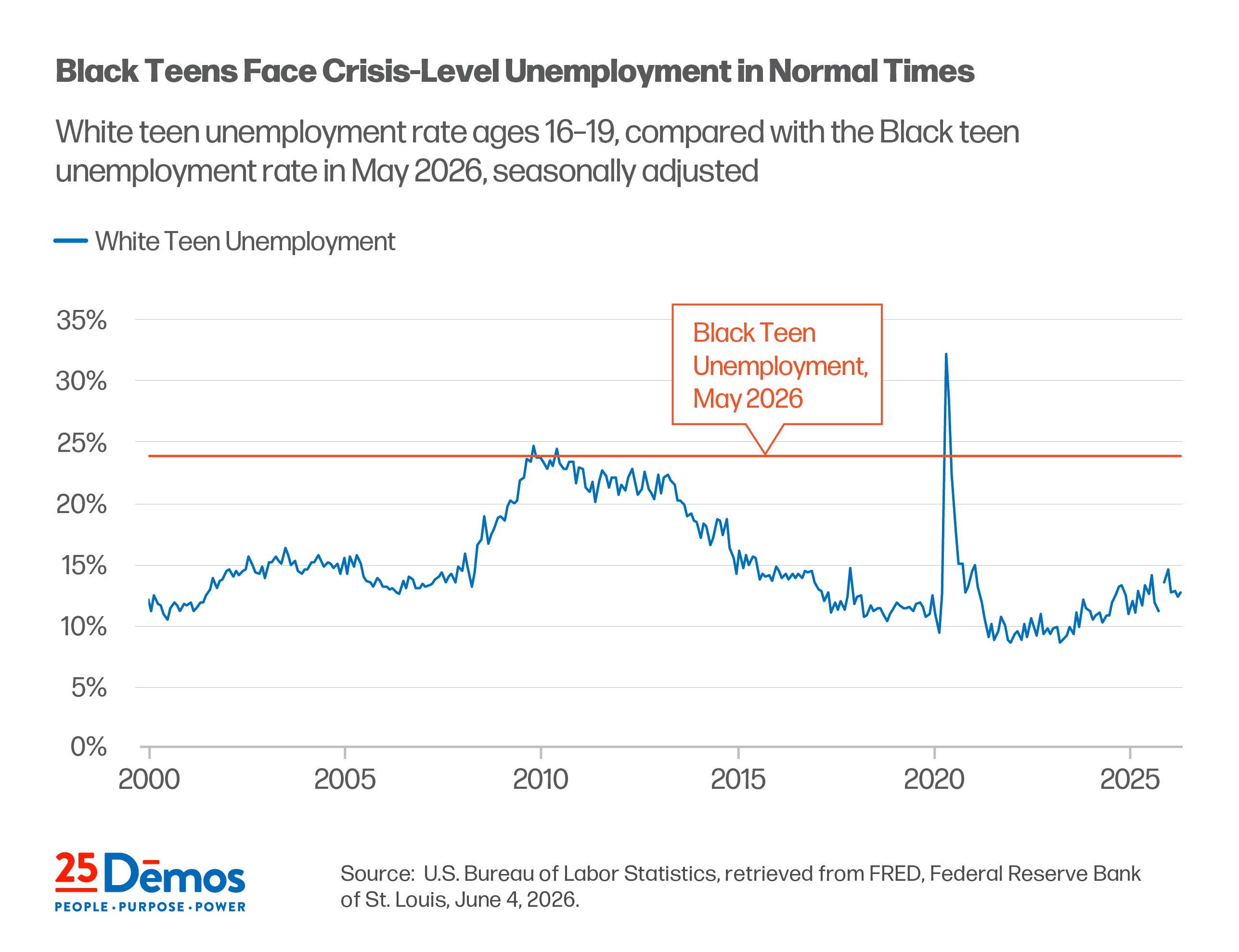
Unemployment rates that have historically been associated with periods of economic crises have become accepted as normal for Black youth.
If you looked only at the overall unemployment rate, you might miss this important indicator. But when nearly one in four Black teens looking for work can't find a job, it raises an important question: For whom is the economy actually working? The answer matters, because unemployment rates that have historically been associated with periods of economic crises have become accepted as normal for Black youth.
Black and Hispanic youth face much higher unemployment rates than their white counterparts. The unemployment rate for Black teens is 23.9 percent, nearly double the 12.1 rate for white teens.
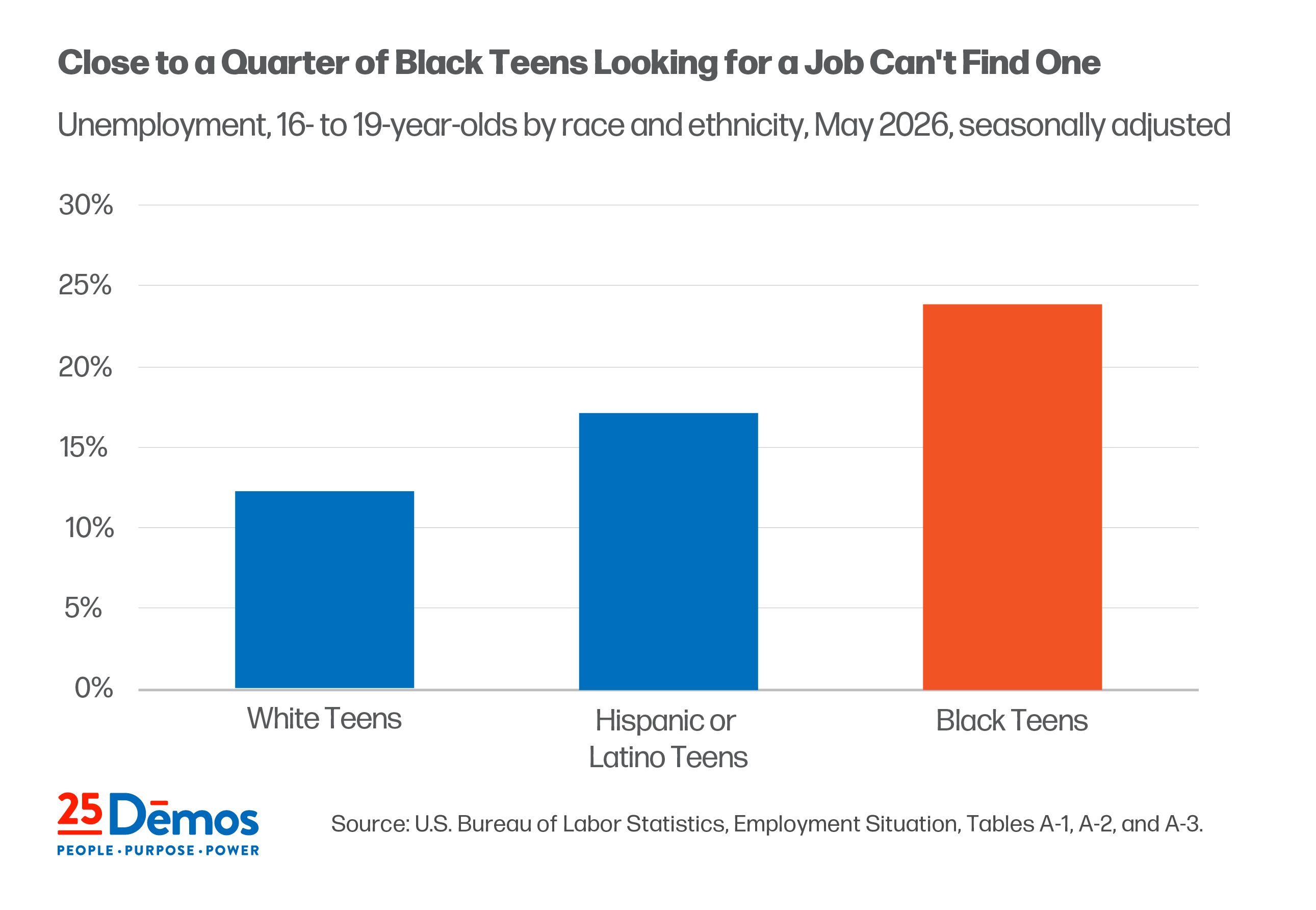
These disparities aren't new. They've persisted for decades. In fact, white teens have generally experienced unemployment rates comparable to those facing Black teens today only during periods of severe economic distress like the Great Recession and the COVID-19 pandemic. These periods were widely recognized as economic crises marked by widespread job loss and significant policy intervention, yet unemployment rates comparable to those experienced by white teens during those crises have become a routine feature of the labor market for Black teens.
There is a range of factors behind these disparities, including discrimination in hiring, unequal access to job opportunities, and differences in access to the networks that can help young people land their first jobs. The scale and persistence of these disparities show that they are caused by systematic exclusion, not individual prejudice alone.
When youth are locked out of the workforce, the consequences can last a lifetime. A first job can help young people build skills and improve future earnings prospects. Youth employment also matters for more-immediate reasons. Many young people work to help support their families' household finances, and this is especially the case for lower-income young people who may not have the financial cushion that higher-income and wealthier households have. When jobs are hard to find, some young people may be able to substitute their time for unpaid internships, volunteer work, or other opportunities. Others do not have that luxury and need paid work.
A healthy labor market should create pathways into work for young people, especially those trying to enter the labor force for the first time.
In an economy where many families face mounting affordability pressures, access to work can affect future opportunities as well as present economic security. A healthy labor market should create pathways into work for young people, especially those trying to enter the labor force for the first time.
When unemployment rates that would signal economic distress for some groups are accepted as routine for others, it suggests that the gains of a strong labor market are not being shared equally. A labor market that works well on average but leaves Black youth behind year after year isn't working as well as the headlines suggest.