Image

Black women are often the first to feel economic pressure and the last to recover. Their unemployment data is a clearer signal of economic health than any topline indicator.
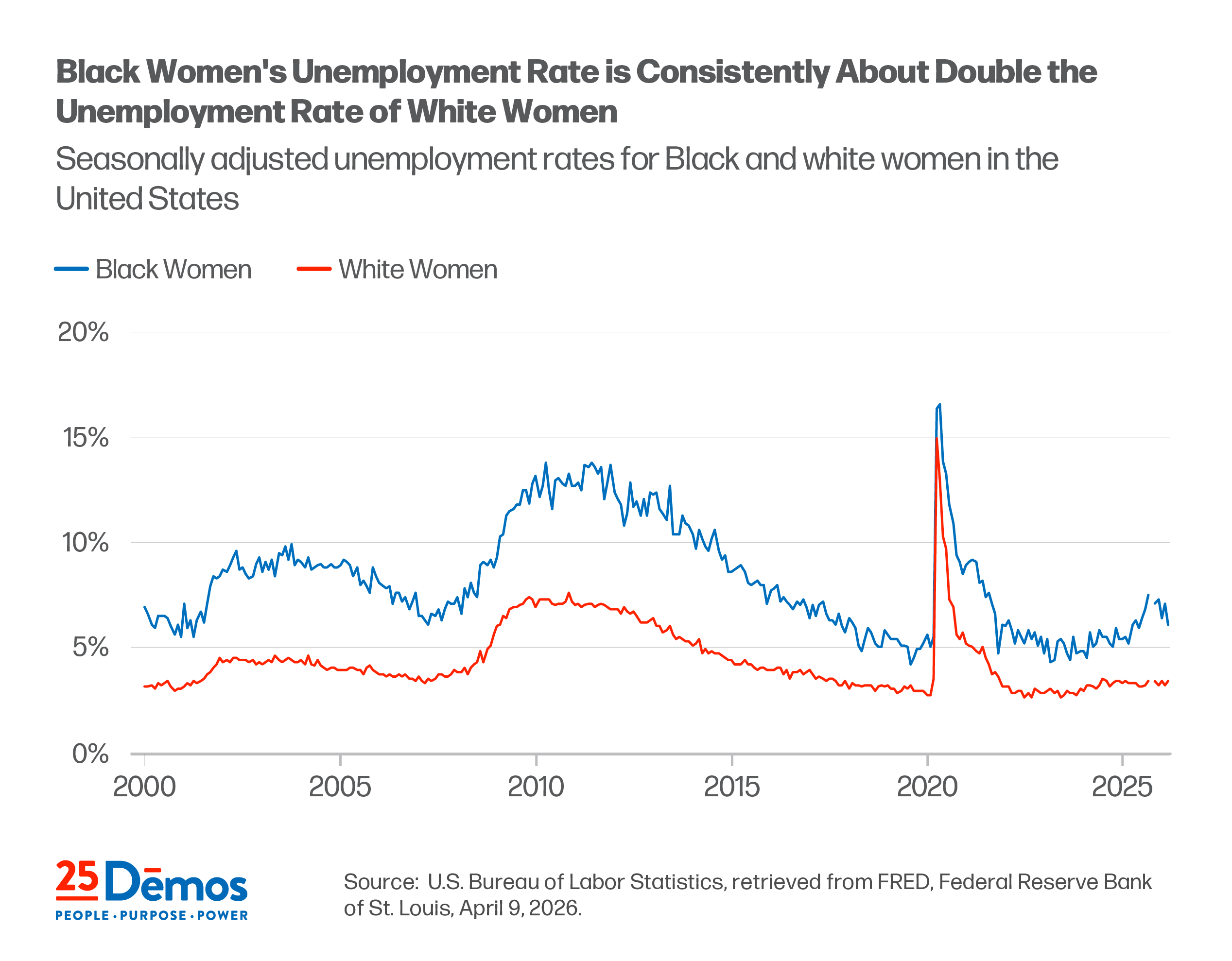
Last month's jobs report was widely framed as evidence that the economy is doing better than expected, maybe even turning a corner. The Trump Administration quickly seized on the numbers as proof of a job well done. But topline indicators can obscure the economic realities many Americans face. One way to see past the headline numbers is to look at the groups most likely to feel economic pressure first – and that often means Black women.
Black women's economic experiences help highlight where the economy falls short, because they are overrepresented in lower-wage and less stable jobs. Black women in the U.S. are typically paid just 63 cents for every dollar paid compared to white, non-Hispanic men, and persistent wealth divides leave many with less financial cushion to weather layoffs, reduced hours, or rising costs. Black women are overrepresented in essential but undervalued sectors such as care, service, retail, and early childhood education. These sectors tend to have lower wages, weaker worker protections, and high turnover. That helps explain why Black women are often among the first to feel and the last to recover from economic downturns.
What would be treated as a crisis for white women is considered normal for Black women.
The latest data makes clear that even when headline indicators suggest the economy is doing well, Black women can still face difficult conditions. Black women's unemployment rate was almost double that of white women’s last month. The last time white women’s unemployment rate was as high as Black women's current unemployment rate was in September 2020, during the COVID-19 pandemic. What would be treated as a crisis for white women is considered normal for Black women. And when economists and politicians claim the economy is “in a good place” or “stabilizing” under such conditions, the message is clear: The economic suffering of Black women is acceptable.
Proposed cuts to critical programs and the rising cost of living rarely show up in headline economic indicators, even as they reshape daily life for the people most affected.
The Trump Administration's latest budget proposal signals cuts to key supports that help low-income people and families stay afloat, including food assistance, nutrition support for women and children, and aid for households struggling to keep up with their energy bills. These cuts come as families continue to face persistent cost-of-living pressures, from groceries to rent, from child care to utilities, all considerations alongside broader uncertainty over geopolitical conflict that could push gas and energy prices even higher. And because last month's labor market data captures conditions in only the first half of March, it doesn't fully reflect the cost of the war in Iran.
Working families across the country are on precarious ground right now, in part because publicly funded programs that provide essential services, like Medicaid, are under threat. While white people account for the largest number of Medicaid beneficiaries, Black and brown people are more likely to depend on Medicaid for health insurance. Black women are among the groups of women with the highest labor force participation, and nearly 80 percent of Black mothers are the sole or primary breadwinners in their households. Black women are also less likely to have paid family and medical leave, because they are concentrated in sectors that often don’t offer these benefits. In the event of a family health emergency that is not covered by insurance or because of cuts to public programs like Medicaid, Black women are more likely to take unpaid time off or leave the workforce entirely. Each of these pressures – low wages, few workplace protections, the threat of losing public benefits – compounds the other, taking an economic toll on Black women that no single statistic can capture.
Publicly funded programs like Medicaid that provide essential supports are more important now than ever. Twenty-three percent of the U.S. population – and nearly half of all children – rely on Medicaid and the Children’s Health Insurance Program (CHIP) for health insurance. And Medicaid is just one example of the essential supports that help families stay afloat. The U.S. still has no federal guarantee of paid medical or family leave, and Black women are disproportionately concentrated in fast-growing job sectors like direct care that rarely offer these benefits. That means a single health emergency can derail a family’s economic stability, a reality that hits Black women hardest, but one that millions of people face.
If Black women are left behind, the economy is not working, no matter what the headlines say.
In a moment of geopolitical instability, rising prices, and policy decisions that will make life harder for working families, we need a more honest assessment of economic health. Headline indicators can obscure the reality that many people are struggling. The Black women’s unemployment rate makes that clear. If Black women are left behind, the economy is not working, no matter what the headlines say.