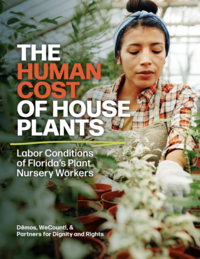
The U.S. plant nursery industry, a $50 billion sector driven by surging demand for houseplants, relies heavily on a workforce that is largely invisible to consumers: women, immigrants, and workers of color who labor under dangerous, low-wage conditions. Florida—producing nearly 70 percent of the nation’s indoor foliage—illustrates the stark contradictions at the heart of this booming industry. Despite the plant nursery industry’s economic success, workers face systemic exploitation rooted in decades of policy exclusions and racial inequities.
Download the full Human Costs of Houseplants report
WeCount!, a worker center in South Florida with a large membership of plant nursery workers, conducted a survey of more than 300 plant nursery workers in Miami-Dade County in 2024. Their findings shed new light on the predicament of plant nursery workers:
- Working Conditions:
- 86 percent of respondents reported accidents or illness on the job; heat stress, pesticide exposure, and other hazardous conditions were some of the leading causes.
- Nearly one-third had no access to water at work, and over 62 percent of those who received water said it was often too dirty and unsanitary to drink.
- Over 60 percent have never received paid sick or vacation days.
- Wages:
- Average pay was $12.57/hour—far below the $22.43 living wage for South Florida.
- Over 20 percent reported never receiving or only sometimes receiving the minimum wage, and more than a third of surveyed workers reported receiving their pay late, another form of wage theft.
- Harassment & Retaliation:
- More than half of women surveyed experienced sexual harassment or discrimination.
- One in six workers faced intimidation for organizing, and more than half of workers reported working in nurseries where workers were fired or retaliated against for exercising their rights on the job.
Federal and state laws exclude agricultural workers from core labor protections, and recent efforts to secure local heat safety standards have been blocked by industry lobbying and state preemption. Traditional corporate social responsibility programs have proven ineffective, prioritizing public relations over worker rights. Worker-driven Social Responsibility (WSR) programs—pioneered by farmworkers in Florida through the Fair Food Program—have transformed exploitative industries by securing legally binding agreements with major buyers, enforcing compliance through independent monitoring, and centering worker leadership. These programs have delivered measurable improvements in wages, safety, and dignity.
WeCount! and plant nursery workers are launching Planting Justice, a WSR initiative modeled on the Fair Food Program. The campaign seeks binding agreements with major retailers and growers to ensure enforceable standards for fair pay, safe working conditions, and protection from harassment and retaliation. Consumer support is strong for changing the industry: In a recent survey, 96 percent of houseplant buyers said they would avoid buying from retailers and plant nurseries engaged in harmful labor practices.
The plant nursery industry exemplifies the urgent need for systemic change. Worker-driven solutions offer a clear path forward—one that prioritizes human rights, economic justice, and sustainability. By supporting Planting Justice, stakeholders can help transform an industry built on exploitation into one rooted in fairness and dignity.
Download the full report to learn more about Planting Justice and WSR initiatives